Friday, October 18, 2013

COL Reginald Heber Kelley

COL Reginald Heber Kelley was born in Fresno, California on 23 Jan 1880. He was the 4th of the 8 sons of Reverend Douglas Ottinger and Anna Amelia (Fletcher) Kelley. His parents had lost their 3rd son soon after birth, just 2 years previous. His father had been born on Kelley's Island, in Lake Erie about 8-10 miles due north of Sandusky, Ohio. Douglas had moved to California in 1867 first working as a lawyer then becoming an Episcopal priest and missionary in California. The Kelleys lived in San Francisco, Watsonville, Alameda and Fresno. The family's home when Reverend Kelley died in 1915 was at 2206 Durant Avenue in Berkley, California. Reginald attended public school in Fresno and is first noted as being on the honor roll in the spring of 1889. He also attended public school in Alameda and San Francisco graduating as valedictorian from Trinity School in San Francisco in 1898. He attended the State University at Berkley and received a scholarship in 1901. 

Enlisting as a PVT on 18 Jun 1898 Reginald served in I Company 7th California Infantry until 2 Dec that same year. He was commissioned as a 1LT in D Company 1st Infantry Regiment, California National Guard in March 1902 where he served while attending university. He was commissioned a LTC in the California National Guard in May of that year due to his outstanding performance in the university's corps of cadets and graduated with a Bachelor of Arts degree. As a result of this he was offered a Regular Army commission as a 2LT of infantry which was accepted and he received the commission in 1903 when he graduated from the University of California. Assigned to the 4th Infantry Regiment, 2LT Kelley departed with the regiment for the Philippines in June 1903. Once there he was posted to Sorsogon in southeastern Luzon. Allowed leave in mid-1905, 2LT Kelley then reported to Fort Thomas, Kentucky. It is probable that 2LT Kelley served with the 4th Regiment in the Ute campaign in1906. Reginald was promoted to 1LT and reassigned to the 5th Infantry Regiment in May 1909 but returned to the 4th after only 1 month and returned to the Philippines until 1910 when the regiment returned to the United States. 

Reginald married Ione Candace Dille on 28 Jun 1910. He was assigned to the 4th Infantry Regiment at Fort Crook, Nebraska at that time. A daughter, Esther Myrick Kelley, was born at Fort Crook on 11 Dec 1911. She would be the couple's only child.

Promotions came quickly during the first World War. Promoted to MAJ on 20 Aug 1917 and assigned as inspector (IG) 29th Division at Camp McClellan near Anniston, Alabama. He went to France with the 29th in 1918 and was detailed at the Division Machine Gun officer to plan and coordinate the machine gun defense in the 29th Division sector. MAJ Kelley was promoted  to LTC on 30 Jul 1918 and to COL on 1 Nov 1918 commanding the 116th Infantry Regiment in the Meuse-Argonne offensive after relieving COL Harris on 10 Oct 1918. He was gassed in training on 4 Dec 1918 and returned from France, 3 Aug 1919. COL Kelley was awarded the Distinguished Service Medal for his service during the war. The citation reads as follows:

"The President of the United States of America, authorized by Act of Congress, July 9, 1918, takes pleasure in presenting the Army Distinguished Service Medal to Colonel (Infantry) Reginald H. Kelley, United States Army, for exceptionally meritorious and distinguished services to the Government of the United States, in a duty of great responsibility during World War I. First as Division Machine-Gun Officer and later as Commanding Officer, 116th Infantry Regiment, 29th Division, Colonel Kelley displayed sterling qualities of leadership. By his high military attainments, sound judgment, and self-sacrificing devotion to duty he proved to be a material factor in the successes achieved by the 29th Division in the offensive actions in which they participated."

He served in the Quartermasters Corps from 13 Aug 1919 to 24 Aug 1919. He graduated from the School of the Line in 1922. COL Kelley then graduated from General Staff School 1923 and from 1923 to 1927 was an associate professor of military science and tactics and the University of California. He attended and graduated from the U.S. Army War College in 1928. COL Kelley was assigned 1929-1932 to Minneapolis, Minnesota as instructor of the National Guard in that state. In 1933 he was at Fort Benning as Director of Department of Experiment.

Ione passed away from injuries sustained in an automobile accident in Newnan, Georgia in 1935. COL Kelley then returned to the Philippines and commanded the 45th Infantry Regiment of the 23rd Infantry Brigade (Philippine Scouts) in 1937 at Fort McKinley, Philippines. It was in 1937 on this tour of duty that he met and married Ruth Steere Reno Fuller on 18 Sep 1937 in a ceremony attended by General and Mrs. Douglas MacArthur. He was next assigned as Chief of Staff of the 87th Infantry Division from 25 Aug 1940 to when he retired 9 Jun 1942 due to disability in line of duty. He was 62 years old at that time. However, it appears that he may have returned to active duty in some roll from 1 Jul 1942 to 20 Feb 1944 due to wartime exigencies. 

After retirement Reginald and Ruth lived a more normal life moving to Melrose, Florida. Reginald became the senior warden of the Trinity church in Melrose and Ruth worked in the Women's Auxiliary of the Diocese of Florida becoming president of that organization. There is little to no public record after his retirement possibly due to health concerns.

COL Kelley died on 18 Oct 1963 in Jacksonville, Florida. He was interred in Arlington National Cemetery in Arlington, Virginia.

Brother of CPT (Chaplain) Leslie Constant Kelley. They were the great, great, great-grandsons of Elihu Stow who was a soldier in the Revolutionary army during nearly the entire war. He enlisted as a private in Capt. Alden's company, Samuel Webb, Colonel, April 21, 1777, was mustered in Nov. 1777, taken prisoner, exchanged, July l, 1778, promoted to Corporal, March 20, 1780; Sergeant, July 1, 1781. Reginald's father had served as a 2LT in B Company 100th Ohio Infantry (USA) during the Civil War. Reginald's daughter together with her husband and 3 of their children were interned in the Philippines by the Japanese during WWII.

Note: This memorial was published 50-years after his death.

Wednesday, August 21, 2013

MG Charles Draper William Canham

MG Charles Draper William Canham was born 26 Jan 1901 in Kola, Mississippi. He was the 4th of the 5 children born to Thomas and Helen (Moll) Canham. His father was a lumber dealer in Mississippi, After the death of his mother in childbirth in 1903, Charles' aunt Gertrude Canham moved to live with the family and help her brother raise his children. They lived for a time in Oregon where his father farmed but he then moved to Detroit, Michigan where he got a job in an auto factory. Thomas Draper died in 1936.

Charles Canham enlisted in the U.S. Army on 23 May 1919. He shipped to France on 13 Jun 1919 as a Field Artillery PVT with the 33rd Company Camp Meade Replacement Unit. Returning to the United States, he married Alma Isabelle Brayton on 18 Aug 1920. By 30 Jun 1921 he was a SGT in the 19th Field Artillery Battalion. SGT Canham tested for and was accepted to the United States Military Academy (West Point) preparatory school and was appointed to USMA effective 1 Jul 1921, graduated in 1926 and commissioned as 2LT 12 Jun 1926. Charles' and Alma's first son was born in January 1922 His first assignment was to Fort Benjamin Harrison.  It was there that his second was born March 1925 followed by a third son in July 1927. In May 1928 he was sent to Camp Knox, Kentucky as the camp personnel adjutant. He attended the Infantry School at Fort Benning, Georgia in September 1930 graduating in June 1931. 2LT Canham  then departed New York on 19 Aug 1931 and arrived in Manial on 3 Oct 1931. He served a period of time in the Philippines and then in Shanghai, China. During this period he was pomoted  to 1LT on 26 Feb 1932 and promoted to CPT 12 Jun 1936.

CPT Canham was assigned to Fort Francis E. Warren, Cheyenne, Wyoming 1937 followed by assignments at Fort Leavenworth, Fort Devens and Providence, Rhode Island. He was promoted to MAJ on 31 Jan 1941 and assigned to European Theater of Operations (ETO) where he was made Deputy Chief of Staff of the 29th Infantry Division. He was promoted to LTC on 1 Feb 1942. LTC Canham was promoted to COL 7 Mar 1943 and assumed command of 116th Infantry Regiment.  COL Canham led the 116th Infantry Regiment on 6 Jun 1944 (D-Day) and was awarded the Distinguished Service Cross (DSC) for his actions in leading troops while wounded. The citation reads as follows:

"The President of the United States of America, authorized by Act of Congress, July 9, 1918, takes pleasure in presenting the Distinguished Service Cross to Colonel (Infantry) Charles Draper William Canham, United States Army, for extraordinary heroism in connection with military operations against an armed enemy while serving as Commanding Officer, 116th Infantry Regiment, 29th Infantry Division, in action against enemy forces on 6 June 1944, at Normandy, France. Colonel Canham landed on the beach shortly after the assault wave of troops had landed. At the time, the enemy fire was at its heaviest and had completely arrested the attack. Though wounded shortly after landing, Colonel Canham, with utter disregard for his own safety, continued to expose himself to the enemy fire in his efforts to reorganize the men. His personal bravery and determination so inspired and heartened the men that they were able to break through the enemy positions. Colonel Canham's outstanding leadership, gallantry and zealous devotion to duty exemplify the highest traditions of the military forces of the United States and reflect great credit upon himself, the 29th Infantry Division, and the United States Army."

Promoted BG 1 Aug 1944 and assigned as Assistant Division Commander of 8th Infantry Division. 8th Infantry Division Commander. It was while he was the ADC of 8th Division that BG Canham was sent to accept the surrender of the German forces in Brest. When General Ramcke asked him for his credentials BG Canham pointed to his accompanying soldiers and said, "These are my credentials." Widely reported at the time, the phrase has become the motto of the 8th Infantry Division.

He continued to serve with the 8th Infantry Division after the war's end and then in December 1945 assumed duties as ADC 4th Infantry Division. Sometime about May 1947, he was assigned as ADC of the 82nd Airborne Division. Late in 1949 BG Canham assumed command of the port of embarkation Bremmerhaven. On 5 Jun 1952 BG Canham was promoted to MG and assumed command of 82nd Airborne Division. Reported as being in Pusan, Republic of Korea on 26 Jan 1953 end of tour in Pusan, ROK. In October 1952 he was named Deputy Commander 3rd Army and in 1953 named for promotion to MG and assumed command of the 3rd Army with headquarters at Fort McPherson, Georgia. 

Then from December 1954 to sometime in 1958 he served as Director of the Army Council of Review Boards after which he assumed command of the 11th U.S. Army Corps (Reserve) in Saint Louis, Missouri. MG Canham retired on 31 Jan 1961. His awards include the Distinguished Service Cross, the Silver Star, the Legion of Merit with 2 Bronze  Oak Leaf Clusters, the Bronze Star with Oak Leaf Cluster, and Purple Heart. 

MG Canham died of an unspecified lung ailment on 21 Aug 1963 and he was interred in Arlington National Cemetery in Arlington, Virginia. He was survived by his wife, sons and their families. 

Note: the published date of this memorial is the 50th anniversary of his passing.

Monday, August 5, 2013

CPL John Armentrout

CPL John Armentrout was born 26 Aug 1832 in Augusta County, Virginia. He was the first born of 9 children of Thomas Hamilton and Barbara (Burkholder) Armentrout. The family farmed near Staunton, Virginia.  Thomas valued his farm at $1,100 in 1850 and in 1860 he valued his farm at $10,300 and reported his personal estate as being worth $2,800. These were very prosperous farmers and John was still farming with his father at that time.

John enlisted as the Commonwealth prepared for war, signing up for the Augusta Greys on 18 Apr 1861 in Greenville, Virginia. The unit was actually mustered into service as E Company 5th Virginia Infantry Regiment on 19 May 1861. John would then have been with the unit when it fought at First Manassas, First  Kernstown, First Winchester, Port Republic, Seven Days Battles, Gaines' Mill, Malvern Hill, Cedar Mountain, Groveton and 2nd Manassas where he was wounded on 30 Aug 1862. CPL Armentrout apparently returned to the unit on or before 30 Jun 1863 just in time for the Battle of Gettysburg where he was wounded in the head on 3 Jul 1863 and captured. Sent to the Federal hospital facility on David's Island in New York, and he died of his wound there on 5 Aug 1863. 

CPL Armentrout's body was eventually returned home and he is now interred in the Pilson Cemetery in Stuart's Draft, Virginia. 

Brother Jacob Christian Armentrout served as a SGT in E Company 5th Virginia, was captured at Winchester in 1862 and spent the rest of the war in the POW camp at Camp Chase, Ohio. John had a 1st cousin 4-times removed  who served as a MSG in Afghanistan in 2004 with the 3rd battalion 116th Infantry.. 


Wednesday, July 3, 2013

BG Richard Brooke Garnett

BG Richard Brooke Garnett was born at Rose Hill, the family home, in Essex County, Virginia on 21 Nov 1817. He and twin, William Henry Garnett, were the fourth and fifth of the nine children born to William Henry and Anna Maria (Brooke) Garnett. Richard received his early education near home and in Norfolk. He graduated from the United States Military Academy at West Point, New York in 1841. He served in the Seminole war with the Sixth Infantry Regiment as a second lieutenant, during the Mexican War and he held a staff position in New Orleans. Promoted to first lieutenant in 1847, Garnett later commanded Fort Laramie (about ninety miles north-northeast of modern Cheyenne, Wyoming) against the sometimes troublesome Sioux, traveled as a recruiting officer, and, after his promotion to captain in 1855, He aided in quelling the Kansas disturbances in 1856-57; was engaged in the Utah expedition. It was while at Fort Laramie that he had a relationship with a Lakota woman, Akitapiwin (Looks At Him Woman also known as Molly Campbell), and had a son born in 1855.

With the coming of the Civil War, CPT Garnett resigned his US commission on 17 May 1861. He was commissioned Major CSA, and in November 1861 Brigadier General in the Provisional Army. Subsequently, he was appointed second-in-command of then Colonel Thomas R.R. Cobb's Georgia Legion, and promoted to Lieutenant Colonel in early September. After brief service with the legion on the Peninsula, Garnett received his promotion to Brigadier General and was immediately assigned to the Shenandoah Valley, coming under command of General Thomas J. Jackson. By spring 1862, BG Garnett commanded Jackson’s old troops, now known as the Stonewall Brigade.  He commanded the Stonewall Brigade in the Shenandoah Valley campaign and at Kernstown, 23 Mar 1862. During the Maryland campaign he commanded Pickett's brigade. General Garnett commanded a brigade in Pickett's Division consisting of the Eighth, Eighteenth, Nineteenth, Twenty-eighth and Fifty-sixth Virginia regiments, which he finally led in "Pickett's Charge" on the third day of the battle of Gettysburg. The brigade went into action with 1,287 men and 140 officers, and after the fight only about 300 effectives remained. General Garnett's part in this fatal action is thus reported by his successor in command, Maj. Charles S. Peyton: 

"Of our cool, gallant, noble brigade commander it may not be out of place to speak. Never had the brigade been better handled, and never has it done better service in the field of battle. There was scarcely an officer or man in the command whose attention was not attracted by the cool and handsome bearing of General Garnett, who, totally devoid of excitement or rashness, rode immediately in rear of his advancing line, endeavoring, by his personal efforts and by the aid of his staff, to keep his line well closed and dressed. He was shot from his horse while near the center of the brigade, within about 25 paces of the stone wall." Source: Confederate Military History, vol. IV, p. 597  

BG Garnett's burial location is unknown. It is believed that his body was stripped of valuables and buried in a mass grave of CSA soldiers at Gettysburg. It may have been later recovered and reinterred in Hollywood Cemetery in Richmond, Virginia. His sword was discovered in a Baltimore pawn shop some years later and returned to the family. 

His cousin, BG Robert Seldon Garnett, was killed commanding CSA forces at the battle of Corrick's Ford on 13 Jul 1861. Son, William P. Garnett, served the U.S. Army as an interpreter and "scout" working primarily from the Pine Ridge Reservation. BG Garnett is survived by numerous living descendants of his son. 

One last note. There is some controversy about the various photographs said to be of BG Garnett with some scholars convinced that all those identified as Richard are of his cousin Robert.

Friday, May 3, 2013

BG Elisha Franklin Paxton

BG Elisha Franklin Paxton was born on 4 Mar 1828 in Rockbridge County, Virginia. He was the sixth of seven children of Elisha Hays and Margaret (McNutt) Paxton. He was descended from the Paxton family which had immigrated to America from northern Ireland in 1730 and settled in Pennsylvania. His father farmed and owned a mill a few miles southeast of Lexington, Virginia. The younger Elisha attended local schools before graduating Washington College in 1846. He then attended Yale University and graduating from there in 1847. He next attended the University of Virginia where he graduated with a law degree in 1848. He had attended the Virginia Military Institute in Lexington but didn't graduate. Elisha married Elizabeth Hannah White in 1854 and the couple had their first child, a daughter, who died in infancy in June of 1856. They would go on to have three more children, all sons. Elisha became president of a bank in Lynchburg, Virginia.

Paxton enlisted in April 1861 as a First Lieutenant (1LT) in H Company 27th Virginia Infantry. 1LT Paxton fought at First Manassas and was commended for gallantry in bearing the colors of a Georgia unit after their color bearer was shot down. He was detailed an Aide-de-Camp on Lieutenant General (LTG) Stonewall Jackson's staff in August 1861. He was then promoted to Major on 14 Oct 1861. In August 1862, he was appointed Major and Quartermaster on Jackson's staff and served as Assistant Adjutant General. On 1 Nov 1862 he was promoted to Brigadier General (BG). Paxton died on 3 May 1863 from a wound received while leading a charge of the Stonewall Brigade at Chancellorsville. Paxton's body was brought back to Lexington and buried at the Stonewall Jackson Cemetery in Lexington, Virginia. He has a number of living descendants. 

Elisha's grandfather, William Paxton served as a Major of militia during the Revolution.

PVT Flemming B. Carroll

courtesy of BigFrench
PVT Flemming B. Carroll was born in 1844 in Augusta County, Virginia probably near the community of West View. He was the 6th of the 9 children of Flemming Solomon and Margaret (Welch or Welsh) Carroll. His father was a fairly prosperous farmer who owned over 500 acres of land in Augusta County. The younger Flemming and his brothers undoubtedly grew up helping their parents with the farming. Margaret died in 1849 or early 1850. The elder Flemming married Sarah Ann Miller in Feb 1851. Sarah was about 24-years younger than her husband and the couple would have several children.Young Flemming grew up to also work as a farm hand. 

Then, when he was just 17-years old, the Civil War began with the shelling of Fort Sumter in South Carolina and Virginia voted for succession about 1-month later. Flemming enlisted in F Company 5th Virginia Infantry on 15 Mar 1862. PVT Carroll was wounded at the 2nd battle of Manassas onn 30 Aug 1862 but recovered by February 1863 and was again with his unit until he was killed in action at Chancellorsville on 3 May 1863.

Originally buried near the Van Wort house at Chancellorsville, PVT Carroll's remains were recovered and re-interred in the Fredericksburg Confederate Cemetery through the efforts of the Ladies Memorial Association of Fredericksburg.

Some of Flemming's brothers also served. Samuel Woodward Carrol served as a PVT in F Company 5th Virginia Infantry and was captured in 1863 serving out the war as a POW at Camp Chase and Rock Island. George Franklin Carrol served as a CPL in D Company 5th Virginia Infantry, was captured 11 Jun 1864 near Fairfield, Pennsylvania and spent the rest of the war as a POW at City Point.


Thursday, January 24, 2013

PVT John T. A. Beard

PVT John T. A. Beard was born about 1844 in Augusta County, Virginia. He was the 3rd of 11 children born to John Link and Martha Margaret (Shields) Beard. His father was a chair maker whose personal estate was valued at $200. The younger John traveled to Mount Jackson and enlisted in I Company 5th Virginia Infantry on 23 Mary 1862. He was with the company all through the Valley Campaign and then the 2nd Battle of Manassas. It wasn't long after the Battle of Fredericksburg when he became ill and was sent to Howard's Grove Hospital in Richmond, Virginia where he died of disease on 24 Jan 1863. PVT Beard was buried in the Hollywood Cemetery in Richmond, Virginia.

Father, John Link Beard, served as a PVT in I Company 14th Virginia Cavalry. Brother, William Sumpter Beard, served as a PVT in D Company 5th Virginia and was wounded at First Kernstown.

Sunday, December 30, 2012

PVT Jacob Carper

PVT Jacob Carper was born in 1830 or 1832 in Frederick County, Virginia. He was the youngest of 8 children of Jacob and Eliza (Keller) Carper. The family had been in Frederick County since at least 1790 and originated in Germany. Jacob's father farmed for himself before he began working for others to support his family.

Jacob was only 17-years old and unmarried when the Civil War began. He enlisted in K Company 5th Virginia Infantry on 10 Oct 1862, probably to be with his brother. PVT Carper's first battle may have been in a skirmish at Kearneysville, Virginia just 17-days later. He was likely then present with his unit for the Battle of Fredericksburg on 13 December. However, he fell ill with typhoid fever and was sent to General Hospital #8 also known as the Saint Charles Hospital in Richmond, Virginia. He died there on 30 Dec 1862.  

We believe that it is likely that PVT Carper is among the thousands of Confederate dead interred at Hollywood Cemetery in Richmond.

Jacob had 3 brothers of whom 2 served in the war. William Harvey Carper served as a PVT in H Company 7th Virginia Cavalry Regiment and was wounded in the arm at Sappony Church, Virginia. George M Carper also served as a PVT in K Company 5th Virginia Infantry Regiment and was killed in action at Spotsylvania Court House on 12 May 1864.

Sunday, November 11, 2012

PVT Ovid L. Abney

PVT Ovid L. Abney was born in 1844 near Mint Spring in Augusta County, Virginia. He was the 7th of the 8 children of William Austin and Virginia Lewis (Kinsolving) Abney. His father was a prosperous farmer with real estate valued at over $11,400 in 1850 and and $19,700 in 1860. His father was the head of a household of 11 which included Ovid's sister Cornelia and her husband John Grills who was the brother of Lycurgus and Charles Washington Grills. The Grills were also first cousins! The country was drifting towards war in 1860. 

Ovid enlisted at Staunton, Virginia in E Company 5th Virginia Infantry (CSA) on 1 May 1862. The regiment left Staunton and marched to McDowell where PVT Abney was present for the battle although the regiment wasn't engaged. He would have then marched with the unit up and down the valley until the 5th Virginia was present for the Battle of Front Royal on 23 May 1862 although, again, it was not engaged. This would have given PVT Abney time to be drilled and to prepare for battle. He was present for the First Battle of Winchester on 25 May 1862. He then moved with the regiment to ultimately arrive at Port Republic for the last battle of Jackson's Valley Campaign. Surviving that, he marched east with the unit over the Blue Ridge mountains to participate in the Seven Days Battles, 25 Jun to 1 Jul 1862, and fought at Gaine's Mill and Malvern Hill. He was then with the regiment for more than a month of movement before fighting at Cedar Mountain on 8 Aug 1962. He would then fight with the 5th Virginia at the Battle of Groveton and at 2nd Manassas (28 Aug to 30 Aug 1862). PVT Abney was at the Battle of Chantilly where the regiment was in reserve and in the capture of Harpers Ferry on 15 Sep 1862. He may have fought at Antietam on 17 Sep 1862 but he might already have been sick with typhoid as he was sent home with the fever to recuperate on 20 Sep 1862. He apparently lingered for quite a while and died on 11 Nov 1862.

PVT Abney is buried with other family including Lycurgus and Charles Washington Grills in the Abney Family Cemetery near Mint Spring, Virginia. 


Saturday, October 6, 2012

PVT James H. Argenbright

PVT James H. Argenbright was born in 1841 near Arbor Hill in Augusta County, Virginia. He was the 3rd of the 13 children of John Augustus and Jane (Dunlap) Argenbright. His father farmed there and may have worked as a distiller of rye whiskey but in 1860 was primarily working as a cooper together with James' older brother, David. 

James enlisted at nearby West View, Virginia on 29 Apr 1861 just 12 days after Virginia voted for succession. He then mustered with F Company 5th Virginia Infantry on 17 May 1861. He was with the unit at Harper's Ferry, the Battle of Falling Waters and, on 21 Jul 1861, the First Battle of Manassas. He was wounded at Manassas but recovered to the point that he returned to F Company on 15 Oct 1861. James was present with the unit as it fought in Jackson's Valley Campaign in the spring and summer of 1862. PVT Argenbright was with his unit at Seven Days, Gaines Mill, Malvern Hill, Cedar Mountain, Groveton, Second Manassas, and the Siege of Harper's Ferry. Then the army moved into Maryland and met the Federal units at Sharpsburg, the deadliest battle to that date. PVT James Argenbright was wounded there and evacuated to J. H. Groves farm where he died of his wound(s) on 6 Oct 1862. 

It is believed that PVT Argenbright was ultimately buried in the Washington Confederate Cemetery at Hagerstown, Maryland.

An uncle and 2 brothers also served in F Company 5th Virginia. Uncle Andrew Jackson Argenbright served as a PVT from 1861 until captured at Spottsylvania Court House in May 1864 and imprisoned at Fort Delaware. Brothers, CPL David Francis Argenbright and PVT Levi Argenbright also served, David enlisting in 1861 and Levi in 1864.

Tuesday, October 2, 2012

1LT Charles Washington Grills

1LT Charles Washington Grills was born in 1842 in Pulaski County, Virginia. He was the youngest of the 5 children of Charles F. and Isabella (Abney) Grills. His mother died age 36 in 1845 and his father died at about age 45 just 5-years later. In 1850 Charles and his older siblings were living with their grandmother, Elizabeth Parks (McClanahan) Abney on her farm near Mint Springs, Virginia. Valued at $1800, Charles' oldest brother John farmed it for the family. The younger children undoubtedly helped with the farm work. Another brother, Byrd, moved with some Abney cousins to Morgan County, Missouri and had built up an estate of $3912 by 1860 but he died in 1861.

Charles enlisted on 18 Apr 1861 in nearby Greenville, Virginia. This was just the day after Virginia voted to succeed from the union. He mustered with E Company 5th Virginia Infantry as the Orderly Sergeant. He was promoted shortly after being commissioned as a 1LT in the company on 23 May 1861. 1LT Grills then fought with the unit until 28 Aug 1862 at the 2nd Battle of Manassas when he was wounded in a leg. The leg had to be amputated. Evacuated to Augusta County, Virginia, near home, he died from complications arising from his wound or the treatment on 2 Oct 1862. 

1LT Grills was buried in the Abney Family Cemetery near Mint Springs, Virginia.  

His brother, Lycurgus Grills, served as an officer in E Company 5th Virginia Infantry commanding it after 2nd Manassas.

Saturday, September 15, 2012

PVT Jeremiah Dinkle

courtesy of Misty Ortiz

PVT Jeremiah Dinkle was born about 1830 in Augusta County, Virginia. He was the 2nd of 5 children born to Jacob and Elizabeth (Showalter) Dinkle. The family lived near Burke's Mill in 1850 where his father farmed and reported an estate of $7000. Jeremiah undoubtedly grew up helping his father farm. Jeremiah married Caroline Sheffer in Rockingham County on 26 Mar 1857. The couple had a son 10-months later near Pudding Spring in northern Augusta County. The couple apparently moved to Burke's Mill, closer to his parents but not adjoining his father's farm. They reported that their estate was valued at $5150 in 1860. With a farm and young family, Jeremiah did not rush to enlist in the first months of succession. 

Whatever motivated him, Jeremiah enlisted in G Company 5th Virginia Infantry on 23 Mar 1862 at Rude's Hill, Virginia. This was likely immediately after the Battle of Kernstown or while it was occuring that same day. This was in the beginning of Jackson's Valley Campaign and Jeremiah would have then fought at McDowell, Front Royal, and Winchester before he became sick with a fever, likely typhoid, and was hospitalized at Winchester where he died on 15 Sep 1862. 

PVT Dinkle was laid to rest with other Confederate soldiers at the Stonewall Cemetery in Winchester, Virginia.

Brother, George William Dinkle, served as a PVT in C Company 52nd Virginia Infantry and died of a fever at home where he'd been sent to recover on 12 Nov 1861. Jeremiah is survived by at least 2 great, great grandchildren.


Thursday, August 30, 2012

PVT John M. Cloud

courtesy of George Seltz
PVT John M. Cloud was born in 1833 in Frederick County, Virginia. He was the 3rd child of 9 and youngest son of William and Nancy Jane (Butterfield) Cloud. His father supported the family as a laborer before becoming a miller. John and his brothers were also working as laborers as early as 1850 when John was 17 and he was working as a farm hand while living with his parents (perhaps on their land) in 1860.

John and his brother enlisted in K Company 5th Virginia on 8 Jun 1861 just 2-days after his brother. The brothers would have fought together at First Manassas and through Jackson's Valley Campaign before the Second Battle of Manassas on 29 and 30 Aug 1862. PVT John Cloud was killed in action on 30 Aug 1862. His body was recovered and he was ultimately buried in the Stonewall Confederate Cemetery in Winchester, Virginia.

John's brother, Amos Cloud, served in C Company 2nd Virginia Infantry and was wounded 3 times but survived the war and brother, Uriah Cloud, served in K Company 5th Virginia Infantry wounded at Hainesville.

COL William Smith Hanger Baylor

COL William Smith Hanger Baylor was born in Augusta County, deep in the Valley of Virginia, on April 7, 1831, the only son of Jacob and Eveline Hanger. His father was an ex-judge who owned a prospering farm near Staunton. Even in his early youth Baylor displayed an unusually pleasing personality. He received his local schooling at the Staunton Academy and, in 1850, graduated from Washington College in Lexington. An outstanding debater, Baylor earned his law degree from the University of Virginia in 1853 and returned home to hang out his shingle. In 1857 he was elected commonwealth's attorney for Staunton and held the post through successive elections until his death. When a local militia company was organized in the late 1850’s, Baylor also was elected captain of the West Augusta Guards, and quickly elevated it to one of the finest militia companies in the state. This unit was one of the first called out to repel John Brown’s raid in October, 1859. But Baylor was not there to lead it. He had gone to New York on his honeymoon, where he was stricken with typhoid fever. However, he was present with the unit at the execution of John Brown.

When several volunteer companies from Augusta County were organized at the beginning of the war in the spring of 1861, Baylor was chosen their colonel. In April the units were ordered to Harper's Ferry and mustered into Confederate service as the 5th Infantry Regiment, Virginia Volunteers; in the reorganization Baylor was appointed major. Thomas J. Jackson wrote at least one letter to Richmond in which he upheld Baylor as his most dependable and deserving subordinate during the critical weeks of organization at Harper's Ferry.

Baylor served with distinction in a skirmish at Falling Waters and again, three weeks later, at Manassas. With the reorganization of the Stonewall Brigade in mid-April, 1862, Baylor was named to the command of the 5th Virginia Infantry. From that moment on, in a unit distinguished for its valor, he set an example. LTC Baylor fought with distinction in Jackson's Valley Campaign and had his horse shot from under him while leading a charge at Winchester forcing him to lead the final assault on foot. During the Seven Days he was cited several times for conspicuous bravery. After the battle of Cedar Run/Cedar Mountain in August 1862, Baylor was given command of the Stonewall Brigade. However his courage and disregard of personal safety made him an easy target in battle, Baylor’s first campaign at the head of the Stonewall Brigade was his last. Just 10 days after assuming command, before his promotion to brigadier could be confirmed, he was killed towards the end of 2nd Manassas, carrying the flag of the 33rd Virginia. Baylor's body was taken from the battlefield and returned to Augusta County where he was buried in the Hebron Presbyterian churchyard.

PVT Smith Bateman

PVT Smith Bateman was born in 1841 in Augusta County, Virginia the 7th of 8 children of Smith and Susan (Lohr) Bateman. His father was a farmer whose property near Staunton, Virginia was valued at $1488 in 1850 $3720 in 1860. 

Smith had enlisted in the 32nd Virginia Militia Regiment before March 1860 but he didn't enlist in H Company 5th Virginia Infantry until 10 Mar 1862. This was just prior to the first battle of Kernstown on 23 Mar 1862 and the beginning of BG Jackson's Valley Campaign. PVT Bateman fought in the battles of that campaign and was apparently noticed because he was promoted to CPL on 16 Jul 1862. He was with the unit in the 2nd battle of Manassas on 30 Aug 1862 in which he was one of the 14 men killed in action.

We believe that he was buried on the battlefield.

His 4 brothers also served during the war PVT William F Bateman was killed in action on 30 May 1864 at Bethesda Church in G Company 52nd Virginia Infantry commanded by brother CPT Elijah Bateman.  George W. and James P. Bateman  served as PVTs in E Company 1st Virginia Cavalry.

Thursday, August 9, 2012

BG Charles Sidney Winder

BG Charles Sidney Winder was born in Talbot County, Maryland on 18 Oct 1829. He was the fifth of seven children of Edward Stoughton and Elizabeth Tayloe (Lloyd) Winder. The Winder family was well established in Maryland and wealthy, owning several thousand acres in the state. Charles' father was an officer in the 2nd Dragoons, commanding A Company in 1837-1840 and away from home much of the time. Charles was educated, as many were at the time, by tutors and being self-taught.

Charles graduated twenty-second in the West Point class of 1850 and then served on garrison and frontier duty for the next ten years. While on board a ship to California in 1854, he displayed outstanding heroism when the the ship was caught in a hurricane. This act earned him promotion to Captain, supposedly the youngest man of that rank in the army at the time. Charles was married in 1855 to Alice Lloyd and the couple would have three children over the next five years. Resigning his commission on 1 Apr 1861, he entered Confederate service as a Major of artillery. He participated in the bombardment of Fort Sumter, South Carolina, and on 8 July of that year he became Colonel of the 6th South Carolina Infantry. COL Winder was promoted to Brigadier General on 7 Mar 1862 and he was selected by Major General Thomas J. "Stonewall" Jackson to command the Stonewall Brigade. A strict, disciplinarian, he enforced the rules, and veterans despised him. BG Winder commanded the Brigade during Jackson's 1862 Shenandoah Valley Campaign. Then, on 9 Aug 1862, during the Battle of Cedar Mountain, he was badly wounded by an exploding shell and died on the field a few hours later.

BG Winder rests forever at Wye House Cemetery in Easton, Maryland.

BG Winder is survived by several living descendants.  His father died at home of an unknown disease contracted while serving at Fort Heilman, Florida in the Second Seminole War. Grandfather, MG Levin Winder, served in the Maryland Line during the revolution and commanded the Maryland Militia after the war and was elected Governor of Maryland, 1812-1815.


Sunday, July 1, 2012

PVT Joseph Allhiser

PVT Joseph Allhiser was born about 1805 in Virginia. He worked as a laborer, probably on somebody else's farm as late as 1850. At that time he and his wife Nancy had 7 children living with them. Their 2 oldest sons, John and James, were also working by that time; John was also working as a laborer and James was working for a miller.

Virginia units had been fighting as part of the Confederate States of America for about 9 months when Joseph, at the age of 57, enlisted in G Company 5th Virginia Infantry on 10 Mar 1862 he may have joined his unit but would have been a raw recruit indeed if he participated in the Battle of Kernstown on 23 Mar 1862. Like many other new soldiers, exposure to the diseases of an army camp and the privations of army life resulted in PVT Allhiser becoming sick and in hospital on 13 Apr 1862. The disease ran its course and PVT Allhiser succumbed to it and died on or just before 1 Jul 1862. 

We do not know if he was returned home for care as were many other soldiers or died where he was initially treated in Stanardsville, Virginia. We do not know where he was buried.

Thursday, June 28, 2012

PVT George Glenn

PVT George Glenn was born 27 Sep 1822 in Augusta County, Virginia. He was the 2nd of 3 children born to John and Margaret Ann (Hartsook) Glenn. He followed in his father's footsteps and took up farming and started a family in 1851 by marrying Barbara Catherine Lowman. George's brother William would marry Barbara's older sister in 1860. The couple soon had children, daughter Elizabeth Margaret in 1852 and son John Abraham in 1855. George was farming near Staunton in 1860. His farm was valued at $900 and his personal estate was $661. 

With the responsibilities of a family and farm George did not enlist until 14 Mar 1862. He mustered with E Company 5th Virginia Infantry. It probably was not a long time until PVT Glenn was on the battlefield because GEN Jackson was conducting what would become known as the Valley Campaign at that time. His first battle may have been Kernstown on 23 Mar 1862 or perhaps McDowell or Front Royal (where the unit was not engaged) on 8 May and 23 May 1862 respectively. He may have been at Winchester on 25 May 1862 but we know he was with the unit at Port Republic on 9 Jun 1862 because it was there that he was wounded. It appears that he was then evacuated to Greenville, Virginia to receive further medical care and he died there on 28 Jun 1862. 

It is possible that being from the area his family was notified shortly after he was wounded and they were able to collect his body at the time of death or shortly after and he was buried with his parents in what is now the Saint John's Reformed Church of Christ Cemetery about 6½-miles from Greenville in Middlebrook, Virginia. Saint John's was a Lutheran church at the time and this is likely the church at which his family worshiped. 

George has several living descendants. 


Wednesday, June 13, 2012

1LT Arthur Jay Arnold

Alexandria Gazette, 23 Jul 1862
1LT Arthur Jay Arnold was born in Alexandria, Virginia on 29 Aug 1838. He was the oldest son and  2nd of 9 children born to John and Ann Elizabeth (Mitchell) Arnold. His father was a hatter and owned a successful hat and fur shop at the corner of King and Royal Streets in what is now "Old Town" Alexandria. Arthur was accepted at the University of Virginia in 1858 and attended for 2 years before becoming a teacher at Sangersville in Augusta County, Virginia. 

It was probably his association with neighbors in Sangersville that caused him to enlist as a SGT in I Company 5th Virginia Infantry. SGT Arnold was promoted to 2LT on 30 Jul 1861 in the aftermath of the 1st Battle of Manassas and was elected on 14 Apr 1862. He fought with the unit from the day he enlisted until wounded at the Battle of Port Republic on 9 Jun 1862. It is probable that he was evacuated with Jackson's soldiers when they crossed the Blue Ridge to rejoin General Lee's army and was sent to Port Royal, Virginia where he died of his wounds on 13 Jun 1862. It is unknown where 1LT Arnorld is buried. 

Only one brother seems to have served in the military during the Civil War and that was John Alexander Arnold who served as a PVT in H Company 17th Virginia Infantry (CSA) and was wounded at 2nd Manassas.

Saturday, June 9, 2012

PVT John Brubeck

courtesy of McCrea-Brady
PVT John Brubeck was born 15 May 1833 in Augusta County, Virginia. He was the 3rd of 8 children born to John and Elizabeth (Snyder) Brubeck.  His father farmed 132 acres valued at $1848 in 1850 with 4 horses, 5 cows and 11 hogs. Young John undoubtedly worked the farm with his father. He married Frances Rebecca Rusmiselle on 17 Dec 1857. The couple farmed on a small 60-acre farm on Smoke Run (now Smoky Row Creek), just west of Staunton, Virginia, and had their first child in March 1859 and a second in 1861.

John enlisted in the "Southern Guard" under the command of CPT H. J. Williams on 17 Apr 1861. He was with the unit when it was mustered into Confederate States service as D Company 5th Virginia Infantry on 1 Jun 1861 and at the battles of Falling Waters, First Manassas, First Kernstown, McDowell, Front Royal, First Winchester, and, finally, at Port Republic where PVT Brubeck was one of nine men killed in action on 9 Jun 1862.

PVT Brubeck was buried at Mount Tabor Luthern Church Cemetery at Middlebrook, Virginia. 

John's wife Frances died of diptheria less than one month after John's death and the two children were apparently raised by their maternal grandmother and other relatives. The couple have many descendants living today.

John's brothers David Franklin Brubeck and James Louis Brubeck also served as PVTs in D Company  and Adam Snyder Brubeck also served as a PVT in D Company 25th Virginia Infantry during the Civil War.

.

CPL John F Doom

courtesy of JMB
CPL John F. Doom was born 7 Mar 1838 in Augusta County, Virginia. He was the 2nd of 10 children born to Madison and Margaret (McAleer) Doom. Madison would support his family in several ways over the years working as a shoemaker in 1850 and a gardener with John in 1860. Madison's total estate was reportedly worth $400 in 1860. By that date only 7 of Madison and Margaret's 10 children were still living. 

John enlisted on 17 Apr 1861 just the day before Virginia voted to succeed from the union. He was mustered into service with L Company 5th Virginia as a PVT on 18 May 1861. PVT Doom then fought at First Manassas and did a stint as an artilleryman before the unit was reconverted from an artillery battery to infantry in April 1862 at which time he was promoted to CPL. GEN Jackson's Valley Campaign wasn't over yet and CPL Doom was present for battles at McDowell, Front Royal, Winchester, and, on 9 Jun 1862 at Port Republic. CPL Doom was killed in action on 9 Jun 1862. 

Being so close to home when he was killed, CPL Doom was returned to Staunton and interred in Thornrose Cemetery there. 

John's younger brother, James M. Doom, also served in L Company 5th Virginia Infantry and was killed in action at The Wilderness in 1864.

PVT James Buchanan Berry

courtesy of Isabelle Chewning
PVT James Buchanan Berry was born 28 Sep 1834 in Augusta County, Virginia. He was the 3rd of the 7 children born to John Ralston and Nancy Hughart (Buchanan) Berry. The family farmed south of Staunton and in 1860 his father reported that his farm was worth $12,750 and that his personal estate was worth $3,840 or as much as $12-million in today's money, successful by any measure. 

James went to Lexington, Virginia and on 10 Mar 1862 he enlisted in the Rockbridge Light Artillery but left the unit on 29 Apr 1862 and mustered into D Company 5th Virginia Infantry on that same day. PVT Berry was then with his company at the Battles of McDowell, Front Royal, and First Winchester although the company apparently was not engaged except at Winchester. This was part of General Jackson's famous Valley Campaign and the next battle was at Port Republic in southeastern Rockingham County, Virginia and PVT James Berry was one of 9 men of the 5th Virginia killed in action there on 9 Jun 1862. 

PVT Berry was buried in what is now the New Providence Presbyterian Church Cemetery with many of his family at Steele's Tavern, Virginia just 38 highway miles from where he was killed.

Both of James' brothers also served during the war. Older brother Charles Gambol Berry served in H Company 27th Virginia Infantry before joining D Company 5th Virginia in October 1864. Younger brother, John Ralston Berry, served in I Company 62nd Virginia Infantry before joining D Company 5th Virginia Infantry. Brother-in-law, John Wilson Beard, also served in D Company 5th Virginia Infantry.

Thursday, May 24, 2012

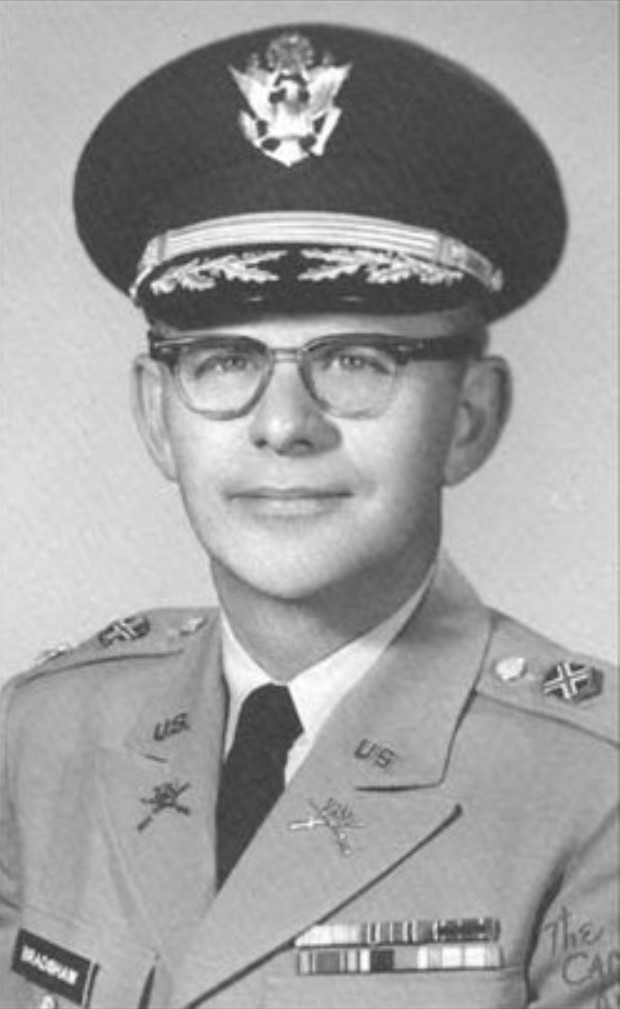
BG Robert Julian Bradshaw

BG Robert Julian Bradshaw was born 11 Mar 1921 in Rice, Virginia. He was the only son and 2nd of the 3 children born to Robert Melville and Ruth Elizabeth (Hubbard) Bradshaw. Both his paternal and maternal ancestors and their relatives had been prominent in Prince Edward and the surrounding counties of Appomattox, Cumberland, Amelia, Nottoway, and Charlotte since before the revolution. His father operated a general store and was a Postmaster at Rice,Virginia for 35 years and farmed as well.

Julian enlisted in G Company 116th Infantry Regiment, Virginia Army National Guard on 21 Jun 1937 and was a SGT in the 116th Infantry Regiment when the unit was federalized on 3 Feb 1941. He was commissioned an Infantry Officer upon graduation from Officer Candidate School class number 119 on 7 Dec 1942. His first duty assignment was as rifle and weapons Platoon Leader, Company G, 300th Infantry The Infantry School, School Troop BDE, Infantry School, Fort Benning, Georgia. he married Nancy Thurber Courter on 6 Jul 1943. He was promoted to 1LT on 16 Mar 1946 and was assigned as Executive and Training Officer, 309 Company, 43rd Replacement battalion, France and Germany. Promoted to CPT on 14 Oct 1946 he was then assigned as Company Commander, Separation Center, Fort Meade, Maryland. He rejoined G Company 116th Infantry in 1947 when the Army National Guard was reorganized following the war. 

Julian and Nancy had a daughter in 1950 and a son in 1951. Executive Officer, Company G, 116th Infantry, 29th Division, Farmville , Virginia (1950-1956). Having previously worked as a U.S. Postal clerk, Julian also took over as Postmaster for the Rice, Virginia post office in 1956. He was President of Bush River Watershed Association in 1970.

He was assigned in 1961 as Adjutant, 1st Battle Group, 29th Division, Roanoke, Virginia, promoted to MAJ on 17 Jan 1963 and assigned as Executive Officer, 2nd Battalion, 2nd Brigade, 29th Division, Lynchburg; promoted to LTC on 20 Nov 1967 and assigned as Assistant G-3/Executive Officer/Battalion Commander, HHC 2d Brigade, 29th Division, VA NG; Operations and Training Offficer/Adjutant General, HHD, Virginia National Guard; Brigade Commander, HHC, 116th Brigade, 28th Division VA NG; Brigade Commander, 3 Infantry, HHC, 116th Infantry Brigade, VA NG; Readiness Coordinator, HHD, Virginia National Guard. 1985 Commander George Washington Division Virginia State Guard.

His awards and decorations include: Reserve and Virginia National Guard Service, Virginia Legion of Merit, World War II Victory Medal, European Theater of Operations (5 Battle Stars), American Theater, American Defense.

Julian divorced Nancy 17 Aug 1980. He married Lucille Bernice Davis on 31 Jan 1981 but they divorced in July 1984. He married Elizabeth Marie Pendleton on 29 Dec 1984. Elizabeth died 29 Feb 2012.

BG Robert Julian Bradshaw passed away 24 May 2012 in Bethesda, Virginia and was interred in Pisgah Baptist Church Cemetery in Rice, Virginia.

Saturday, April 28, 2012

PVT John Robert Athey

PVT John Robert Athey was born 26 Oct 1842 in Frederick County, Virginia. He was the youngest of the 4 children of Elisha or Elias J. and Emily (Ritter) Athey. Emily died in August 1845 and John's father married Emily's sister Alsinda before the year ended. Elisha and Alsinda would have 5 children together. His father was a weaver. In 1860 his father was working as a day laborer although he would return to weaving after the war. John was living with his father and step-mother/aunt, near Brucetown, Virginia and working as a hired hand on a local farm. 

Before BG Jackson began his valley campaign he moved to Winchester in an attempt to engage BG Banks forces but Banks would not engage. While the Confederate forces were in Winchester, John's brother William enlisted in A Company 5th Virginia Infantry on 11 Mar 1862. We don't know if his older brother's example motivated 19-year old John to enlist but he apparently went to the Stonewall Brigade in camp at Mount Jackson, Virginia and enlisted in I Company 2nd Virginia Infantry on 14 Mar 1862. He then fought with the unit at the first battle of Kernstown on 23 Mar 1862 only 9 days after enlisting. He was uninjured in that battle but he fell ill and was evacuated to a hospital in Lynchburg. He died there of pneumonia on 28 Apr 1862 just 5-days after his older brother. 

Like many of the soldiers who died in Lynchburg hospitals including his brother, PVT Athey is buried in the Lynchburg City Cemetery.

Wednesday, April 25, 2012

COL Thomas Spencer Dallas Sr.

Thomas as a Lieutenant in 1939
COL Thomas Spencer Dallas Sr. was born 12 Dec 1913 in Rockingham County, North Carolina, probably Leaksville. He was the 2nd of 5 children born to Philip Kyle and Della Ruth (Spencer) Dallas. His father worked as a clerk. The family moved to Martinsville, Virginia before 1930 where Philip worked as an insurance agent and later operated a grocery store. By 1940 he was working as a supply clerk in an auto shop.

Thomas enlisted in the local National Guard unit, H Company 116th Infantry, in 1932. He rose in rank to SGT by 1937 and then attended officer training and was commissioned as a 2LT on 10 Feb 1937. Thomas was again promoted, to 1LT, on 2 Mar 1939. He was with the unit when it was federalized on 1 Feb 1941 and the unit was still at Fort Meade, Maryland when he was promoted to CPT on 25 Aug 1941 when he was made 1st Battalion's S-1/Adjutant.

It was just a month later that Thomas married Fannie Mildred Graham of Martinsville. The couple likely didn't have much time together as the 116th was sent to Camp Blanding for further training before departing for England aboard the Queen Mary in September 1942.  His first son would be born 12 Nov 1942. While in England, the 116th trained for the amphibious assault that would be a major element of the invasion of occupied northern France. The now MAJ Dallas came ashore in the 1st wave as Battalion Executive Officer at Omaha Beach, surviving the landing and helping to lead his battalion inland. For these efforts he would receive the Silver Star. On 29 Jun 1944 MAJ Dallas assumed command of 1st Battalion 116th Infantry. Thomas was wounded on 5 Aug 1944 and evacuated to hospital. He was not returned to the unit, coming by way of the replacement depot, on 7 Sep 1944.  Only 7 days later he would lead the battalion in an action for which he is much remembered, the capture of Fort Montbarey.


MAJ Dallas in Germany
Although he had what was described as a round "cherubic" face, MAJ Dallas had a reputation for a fierce temperament and was thought to be a solid combat leader. MAJ Dallas was supported by B Squadron, 141st Regiment, Royal Armored Corps; a platoon of the 644th Tank Destroyer Battalion (with 4 M-10s); part of B Company, 121st Combat Engineer Battalion; B Company 86th Chemical Mortar Battalion; and some 105mm cannon from Cannon Company 116th Infantry. A detailed story would be too long for this account but Dallas had the combat engineers clear several paths through the minefield surrounding the fort which task had to be accomplished in the dark. C Company would conduct an all-day fight to take control of the outer defenses on the west side of the fort. The 141st's Crocodile tanks (flamethrowers) went up against the fort by firing on the embrasures and they were supported by conventional tanks. The Crocodiles made it through and as B Company moved forward they were able to capture almost 80 of the enemy. The Americans needed to enter the fort and brought up the Crocodiles, tanks and even a 105mm cannon to fire on the gate. White phosphorus rounds fired through the gate into the courtyard apparently made a wreck of that part of the fort but there was still no entry to the courtyard. There was another passage and again, tank and cannon fire was used to open an access hole. The 121st Engineers managed to move nearly 1-ton of TNT into the hole and under a critical point of the north wall. It was now the 16 Sep 1944. After the recovery of the body of 2LT Durwood Settles (who MAJ Dallas knew from H Company pre-war, the charge was set-off at about 1700 hours. The explosion had the effect of collapsing the north wall so much that ladders weren't necessary for the soldiers who rushed in to capture the stunned German soldiers.

Dallas would receive a promotion to LTC on 12 Oct 1944. LTC Dallas sprained his leg on 27 Nov 1944 but remained on duty. On 3 Dec 1944 he was sent to hospital for "an old wound" but it is unclear what that wound was. LTC Dallas returned to his duties as Battalion Commander on 22 Dec 1944. He left for temporary duty in Britain on 24 Jan 1945 and returned to the unit on 1 Feb 1945. LTC Dallas left for another 3-days temporary duty in Britain on 25 Mar 1945 and was back with the unit on the 30th.

After demobilization, LTC Dallas helped to reactivate the National Guard. He returned to active duty in June 1951. He would take his family with him for a tour of duty in Japan in 1955. By 1962 COL Dallas was senior Army advisor to the Alaska National Guard. On 25 Apr 1962 the helicopter in which he was riding crashed and he and 7 other passengers and crew were killed.

COL Dallas was buried with his wife in Arlington National Cemetery in Arlington, Virginia.

Great-grandfather Joshua Thomas Spencer served in E Company 1st Virginia Infantry (CSA). Great-grandfather William Hagood served as a PVT in G Company 21st Virginia Cavalry and K Company 6th Virginia Infantry (CSA). 

Note: this memorial was published on the 50th anniversary of COL Dallas passing due to the limitations imposed by Blogger.