Showing posts with label Commander. Show all posts

Monday, April 13, 2020

MG Wendell Lynn Seldon

MG Wendell Lynn Seldon was born 5 Oct 1929 in High View, West Virginia the first of the 2 children born to Marvin Frederick and Lacey Virginia (Brill) Seldon. Paternal grandfather, Frederick John Seldon, had come to the United States from England as an infant in 1873. While his great-grandfather and grandfather had farmed his father worked in sales. Wendell's life story was very well summed up in his published obituary, 

"Wendell’s career in local and state government began in 1947, when he was appointed Assistant City Manager of Winchester, VA, and served as City Manager from 1967 to 1986. In 1976 he received the honor of “Public Administrator of the Year” by the Virginia Chapter of the American Society for Public Administration. The City awarded him by Resolution and a Farewell Roast in 1986. In addition, he was awarded a Certificate of Life Membership in the Virginia Section of International City Management Association in 1986, where he had served as President from 1977-1978. In recognition of his distinguished service at the local level, he was the recipient of an award from the Marsh Institute for Government and Public Policy at Shenandoah University in 1997. He served as Range Rider for the Virginia Local Government Management Association in the Winchester and Richmond areas.

Governor Baliles appointed Wendell to the position of Director of General Services beginning July 1, 1986. He was reappointed by Governor Wilder in January 1990 and served until his retirement October 1, 1991. The Commonwealth of Virginia honored him in a joint House and Senate Resolution, upon his retirement. He served on Governor Allen’s Commission on Government Reform (Blue Ribbon Strike Force) in 1994. He served as Legislative Aide to Senator Russ Potts of Winchester since his election in 1992 for 16 years and then for Senator Jill Vogel until 2008.

In addition to his full-time positions, Wendell was a member of the Virginia Army National Guard from 1948 through 1989, when he retired with the rank of Brigadier General. He rose through the enlisted ranks and graduated from the USA Infantry School Associate Infantry Officers Career Course, U.S. Command and General Staff College and was appointed to the rank of Brigadier General in 1985. BG Seldon’s last assignments included Commander of the 116th Infantry Brigade, Assistant Division Commander of the 29th Infantry Division (Light), and Deputy STARC Commander of the Virginia National Guard Headquarters in Richmond. His decorations and awards include the Virginia National Guard Commendation Medal and Bronze Star for Meritorious Service, the Army Reserve Components Achievement with one Oak Leaf Cluster and the Army Achievement Medal, Commendation Medal, and Legion of Merit. He was promoted to Major General in the Virginia Militia Unorganized, upon his retirement. He served on the Military Staff of Governors Baliles, Wilder, and Allen. General Seldon served as Honorary Colonel of the 116th Infantry Regiment from 1997 to 2006.

Wendell has been involved with various civic and professional organizations; including serving as President of the Winchester Rotary Club; Chairman of the Winchester Salvation Army Advisory Board; President, Virginia Section, International City Manager’s Association; and President of the National Association of Directors of Administration and General Services.

His other activities included basketball and football officiating at the high school and college levels for more than 40 years, officiating more than 1,000 basketball and 800 football games. He served as Commissioner of the Winchester Officials Association for 34 years. He was inducted into the Virginia High School League’s Hall of Fame in October 1993."

MG Seldon passed away on 13 April 2020 and rests forever in the Mount Hebron Cemetery in Winchester, Virginia.

Tuesday, December 5, 2017

MG Kenton Harper

MG Kenton Harper was born in 1801 in Chambersburg, Pennsylvania to George Kenton and Nancy (McClintock) Harper. He was the first of their two sons and his father was for many years the editor of The Franklin Repository, a newspaper published in Chambersburg. Kenton worked in the newspaper office learning the trade and not long after the age of twenty-one he moved to Staunton, Virginia and in 1823 began publication of his own paper, The Spectator which he did for sixteen years. During the administration of President Millard Fillmore, Kenton became an agent to the Indian Territory and after than a "confidential" assistant to the Secretary of the Interior. He also served in the Virginia House of Delegates representing Augusta County. 

Appointed as an officer of the Virginia Militia he was, in 1861, a Major General (MG) of the militia and had command of forces that captured Harpers Ferry. On reorganization of the Confederate States military he accepted a commission as Colonel of the 5th Virginia Infantry, commanding the unit at Falling Waters and First Manassas. He resigned his commission when Jackson would not give him leave to visit his dying wife but later accepted a position as Colonel in the Virginia reserves and was present at the battles of Piedmont and Waynesboro.

MG Kenton Harper died at his home, "Glen Allen", on 25 Dec 1867. He now rests forever in the Thornrose Cemetery in Staunton, Virginia.

Son, Samuel Calhoun Harper, served as Quartermaster Sergeant in the 62nd Virginia Mounted Infantry (CSA).

Saturday, April 29, 2017

LTG James Alexander Baber III

LTG James Alexander Baber III was born 4 Nov 1929 in Richmond, Virginia. He was the eldest of James Alexander and Edna Earl (Jenkins) Baber's 2 sons. The family lived with his grandfather, James Alexander Baber Sr. in his home at 1426 Perry Street in Richmond which his grandfather owned and was valued at $7000 in 1930. At the time his grandfather was working as a gas meter inspector and his father as a presser in a print shop. His grandmother died in 1935 and grandfather in 1939 and the home passed to his father who was now working as a clerk for the Virginia Alcoholic Beverage Control Commission earning a reported $1680 in 1939. By 1950 the family had moved to 132 East Belt Boulevard in Manchester, Virginia although James was attending college in Williamsburg.

His professional life is well described in his obituary published at the time of his death. "Jim attended John Marshall High School and excelled in both football and baseball, where he was voted to all-city and all-state in both sports. His leadership was not only exemplified on the playing field but also as a leader in the ROTC program, where he served as Battalion Commander. After graduating from John Marshall, he attended The College of William and Mary earning his B.A. degree in 1952. His passion for football and baseball continued throughout his college years and he excelled in both sports. He was later inducted into the ROTC Hall of Fame. 

Upon graduation, Jim was commissioned as an officer in the United States Army and was assigned as Division Artillery Survey Officer, 1st Calvary Division in Japan during the Korean War. He was honorably discharged from active duty in 1954, whereupon he joined the Virginia National Guard. He served as Commander of various National Guard Units within the Commonwealth and was federally recognized as Brigadier General in 1979. The pinnacle his career was when Jim was appointed Commander of the 29th Infantry Division of Virginia and Maryland in 1985 and federally recognized as Major General. He had risen to the two star rank before retiring as a designated three star General. For his service, Jim received the Meritorious Service Medal, Army Commendation Medal, National Defense Service Medal, Korean Service Medal, United Nations Service Medal, Virginia National Guard Distinguished Service Medal, Maryland National Guard Distinguished Service Medal, Virginia Army National Guard Service Medal, and the Virginia Army National Guard Bronze Star. 

From the very beginning, Jim was fated to be an inspiring leader. With his troops, he enjoyed a deep rapport and the camaraderie of lifelong friends. Jim received his Doctor of Jurisprudence in 1957 from T.C. Williams School of Law, University of Richmond, where he also led as Student Body President and was a member of the National Moot Court Team, Omicron Delta Kappa National Leadership Society and McNeill Law Society. He was admitted to the Virginia State Bar in 1956 and practiced Criminal Defense and Civil Litigation law for over 50 years in Federal and State Court. He also served as a substitute Judge in the Richmond General District Court and surrounding counties for 26 years. He was Senior Partner at Bremner, Baber and Janus Law Firm. He distinguished himself by his take charge leadership and relentless work ethic. His great soldiery quality was matched by his desire to win battles for his clients and win the cases. Every case was a win-win because Jim saw the redemptive quality in every person no matter the outcome and treated everyone with dignity and respect. 

Jim was a 54-year member of the Fraternal Order of Freemasons at the Manchester Lodge #14 of Richmond. He was committed to the values of the Fraternal Order. Jim often quoted from an old Army song, "Old Soldiers Never Die, They Just Fade Away."  Besides his work for the Shriners in the Directors Staff, he was also charitable in less formal ways. "

MG Baber died 29 Apr 2017 and rests forever in the Westhampton Memorial Park in Tuckahoe, Virginia. 

Great-grandfather, John Avery Cersley, served as a PVT in I Company 6th Virginia Infantry (CSA) during the Civil War.

Monday, March 2, 2015

COL William Henry Harman

COL William Henry Harman was born 17 Feb 1828 in Waynesboro, Virginia. He was the second of the five brothers born to Lewis and Sarah Jane (Garber) Harman, all of whom would serve as officers in the Confederate States army during the Civil War. His father farmed in Augusta County. Like his brothers, William was given a private education. 

William left home to serve as a 2LT in the 1st Virginia Infantry Regiment during the Mexican American War. After his return he studied law and married Margaret Susan Garber on 26 Dec 1848. He began work as a lawyer and was elected Commonwealth's Attorney for Augusta County, Virginia in 1851 and held the position until the Civil War. 

William and Margaret had eight children. Their second child, Frances, died at the age of 2 of an undisclosed (or unknown) cause in 1850. Their eldest child, Kenton, died of a "sore throat" at the age of 7 in 1857. 

William was appointed Brigadier General of the 13th Brigade of Virginia Militia by Governor John Letcher on 10 Apr 1861. As such he was part of the plot initiated by former governor Henry Wise to preemptively seize the federal arsenal at Harper's Ferry (now in West Virginia). After Virginia voted for succession on 17 Apr 1861, Governor Letcher approved the plan and BG Harman's troops under MG Kenton Harper captured the post on 18 Apr 1861. 

The 5th Virginia Regiment was organized there with COL Kenton Harper commanding and LTC William Harman as what would now be referred to as the executive officer. The regiment was assigned to BG Thomas "Stonewall" Jackson's brigade (1st Virginia Brigade) and William's brother, COL Michael Garber Harman was initially the brigade's quartermaster and he was soon succeeded by their brother MAJ John Harman. The unit fought at First Manassas on 21 Jul 1861 where General Jackson received his nickname. William succeeded as commander of the 5th Virginia in September 1861 when COL Harper resigned. COL Harman commanded the regiment at the First Battle of Kernstown on 23 Mar 1862. He was not elected as Colonel of the regiment in the April 1862 reorganization of the Confederate army. Instead he served as an aide-de-camp to Brigadier General Edward "Alleghany" Johnson in the Valley Campaign in April 1862 and then returned home. 

He was appointed Assistant Adjutant General on 19 Feb 1864. He commanded a regiment of militia/reservists/home guard at the Battle of Piedmont on 5 Jun 1864. He survived that defeat and continued to serve. He was present to command CSA soldiers at the Battle of Waynesboro and was killed in action while attempting to rally his soldiers on 2 Mar 1865.

COL Harman's body was recovered and interred in Thornrose Cemetery in Staunton, Virginia. He is survived by numerous descendants. His brothers worked towards economic recovery for the region.

Sunday, September 21, 2014

COL John Henry Stover Funk

COL John Henry Stover Funk was born in Frederick County, Virginia on 28 Jun 1837. He was the eldest of the four children born to Christopher and Elizabeth (Arnold) Funk. His father was a brick mason and the family lived on Market Street in Winchester, Virginia, the county seat of Frederick. Called "Stover" by his friends, John graduated from the Winchester Medical College in Winchester and began a medical practice in Farmington, Virginia (in Marion county in what is now West Virginia) in August1860.

When the Marion Rifles, a militia unit was formed in Marion County, John was elected Captain of the company. He enlisted, together with the other members of his unit, on 18 Apr 1861 and the unit was re-designated as A Company of the 5th Virginia Infantry Regiment. He and his company fought at First Manassas. In April of 1862, with the reorganization of the army, Funk was elected Lieutenant Colonel of the regiment then, after Colonel Baylor was killed leading the brigade at Second Manassas, Funk became Colonel of the regiment. When Brigadier General Paxton was killed at Chancellorsville, he temporarily commanded the brigade as the senior Colonel. He reverted to command the regiment when Brigadier James A. Walker ("Stonewall Jim") was assigned to command the brigade on 19 May. He fought at Culps Hill at Gettysburg. When the brigade was overwhelmed at the Mule Shoe on 12th May 1864, Funk was put in nominal command of the remnants of the Stonewall Brigade, while Col. William Terry (who was nearly a full year junior in seniority to Funk) was promoted to command the full brigade of the remnants of the rest of the division. Funk would serve with the "Stonewall Regiment" until he was mortally wounded at the Third Battle of Winchester, 19 Sep 1864. He died of his wound at his father's home 2 days later on 21 Sep 1864.

COL Funk is buried next to his brother, 1LT Jefferson William Obet Funk, in the Mount Hebron Cemetery in Winchester, Virginia. 


Friday, October 18, 2013

COL Reginald Heber Kelley

COL Reginald Heber Kelley was born in Fresno, California on 23 Jan 1880. He was the 4th of the 8 sons of Reverend Douglas Ottinger and Anna Amelia (Fletcher) Kelley. His parents had lost their 3rd son soon after birth, just 2 years previous. His father had been born on Kelley's Island, in Lake Erie about 8-10 miles due north of Sandusky, Ohio. Douglas had moved to California in 1867 first working as a lawyer then becoming an Episcopal priest and missionary in California. The Kelleys lived in San Francisco, Watsonville, Alameda and Fresno. The family's home when Reverend Kelley died in 1915 was at 2206 Durant Avenue in Berkley, California. Reginald attended public school in Fresno and is first noted as being on the honor roll in the spring of 1889. He also attended public school in Alameda and San Francisco graduating as valedictorian from Trinity School in San Francisco in 1898. He attended the State University at Berkley and received a scholarship in 1901. 

Enlisting as a PVT on 18 Jun 1898 Reginald served in I Company 7th California Infantry until 2 Dec that same year. He was commissioned as a 1LT in D Company 1st Infantry Regiment, California National Guard in March 1902 where he served while attending university. He was commissioned a LTC in the California National Guard in May of that year due to his outstanding performance in the university's corps of cadets and graduated with a Bachelor of Arts degree. As a result of this he was offered a Regular Army commission as a 2LT of infantry which was accepted and he received the commission in 1903 when he graduated from the University of California. Assigned to the 4th Infantry Regiment, 2LT Kelley departed with the regiment for the Philippines in June 1903. Once there he was posted to Sorsogon in southeastern Luzon. Allowed leave in mid-1905, 2LT Kelley then reported to Fort Thomas, Kentucky. It is probable that 2LT Kelley served with the 4th Regiment in the Ute campaign in1906. Reginald was promoted to 1LT and reassigned to the 5th Infantry Regiment in May 1909 but returned to the 4th after only 1 month and returned to the Philippines until 1910 when the regiment returned to the United States. 

Reginald married Ione Candace Dille on 28 Jun 1910. He was assigned to the 4th Infantry Regiment at Fort Crook, Nebraska at that time. A daughter, Esther Myrick Kelley, was born at Fort Crook on 11 Dec 1911. She would be the couple's only child.

Promotions came quickly during the first World War. Promoted to MAJ on 20 Aug 1917 and assigned as inspector (IG) 29th Division at Camp McClellan near Anniston, Alabama. He went to France with the 29th in 1918 and was detailed at the Division Machine Gun officer to plan and coordinate the machine gun defense in the 29th Division sector. MAJ Kelley was promoted  to LTC on 30 Jul 1918 and to COL on 1 Nov 1918 commanding the 116th Infantry Regiment in the Meuse-Argonne offensive after relieving COL Harris on 10 Oct 1918. He was gassed in training on 4 Dec 1918 and returned from France, 3 Aug 1919. COL Kelley was awarded the Distinguished Service Medal for his service during the war. The citation reads as follows:

"The President of the United States of America, authorized by Act of Congress, July 9, 1918, takes pleasure in presenting the Army Distinguished Service Medal to Colonel (Infantry) Reginald H. Kelley, United States Army, for exceptionally meritorious and distinguished services to the Government of the United States, in a duty of great responsibility during World War I. First as Division Machine-Gun Officer and later as Commanding Officer, 116th Infantry Regiment, 29th Division, Colonel Kelley displayed sterling qualities of leadership. By his high military attainments, sound judgment, and self-sacrificing devotion to duty he proved to be a material factor in the successes achieved by the 29th Division in the offensive actions in which they participated."

He served in the Quartermasters Corps from 13 Aug 1919 to 24 Aug 1919. He graduated from the School of the Line in 1922. COL Kelley then graduated from General Staff School 1923 and from 1923 to 1927 was an associate professor of military science and tactics and the University of California. He attended and graduated from the U.S. Army War College in 1928. COL Kelley was assigned 1929-1932 to Minneapolis, Minnesota as instructor of the National Guard in that state. In 1933 he was at Fort Benning as Director of Department of Experiment.

Ione passed away from injuries sustained in an automobile accident in Newnan, Georgia in 1935. COL Kelley then returned to the Philippines and commanded the 45th Infantry Regiment of the 23rd Infantry Brigade (Philippine Scouts) in 1937 at Fort McKinley, Philippines. It was in 1937 on this tour of duty that he met and married Ruth Steere Reno Fuller on 18 Sep 1937 in a ceremony attended by General and Mrs. Douglas MacArthur. He was next assigned as Chief of Staff of the 87th Infantry Division from 25 Aug 1940 to when he retired 9 Jun 1942 due to disability in line of duty. He was 62 years old at that time. However, it appears that he may have returned to active duty in some roll from 1 Jul 1942 to 20 Feb 1944 due to wartime exigencies. 

After retirement Reginald and Ruth lived a more normal life moving to Melrose, Florida. Reginald became the senior warden of the Trinity church in Melrose and Ruth worked in the Women's Auxiliary of the Diocese of Florida becoming president of that organization. There is little to no public record after his retirement possibly due to health concerns.

COL Kelley died on 18 Oct 1963 in Jacksonville, Florida. He was interred in Arlington National Cemetery in Arlington, Virginia.

Brother of CPT (Chaplain) Leslie Constant Kelley. They were the great, great, great-grandsons of Elihu Stow who was a soldier in the Revolutionary army during nearly the entire war. He enlisted as a private in Capt. Alden's company, Samuel Webb, Colonel, April 21, 1777, was mustered in Nov. 1777, taken prisoner, exchanged, July l, 1778, promoted to Corporal, March 20, 1780; Sergeant, July 1, 1781. Reginald's father had served as a 2LT in B Company 100th Ohio Infantry (USA) during the Civil War. Reginald's daughter together with her husband and 3 of their children were interned in the Philippines by the Japanese during WWII.

Note: This memorial was published 50-years after his death.

Wednesday, August 21, 2013

MG Charles Draper William Canham

MG Charles Draper William Canham was born 26 Jan 1901 in Kola, Mississippi. He was the 4th of the 5 children born to Thomas and Helen (Moll) Canham. His father was a lumber dealer in Mississippi, After the death of his mother in childbirth in 1903, Charles' aunt Gertrude Canham moved to live with the family and help her brother raise his children. They lived for a time in Oregon where his father farmed but he then moved to Detroit, Michigan where he got a job in an auto factory. Thomas Draper died in 1936.

Charles Canham enlisted in the U.S. Army on 23 May 1919. He shipped to France on 13 Jun 1919 as a Field Artillery PVT with the 33rd Company Camp Meade Replacement Unit. Returning to the United States, he married Alma Isabelle Brayton on 18 Aug 1920. By 30 Jun 1921 he was a SGT in the 19th Field Artillery Battalion. SGT Canham tested for and was accepted to the United States Military Academy (West Point) preparatory school and was appointed to USMA effective 1 Jul 1921, graduated in 1926 and commissioned as 2LT 12 Jun 1926. Charles' and Alma's first son was born in January 1922 His first assignment was to Fort Benjamin Harrison.  It was there that his second was born March 1925 followed by a third son in July 1927. In May 1928 he was sent to Camp Knox, Kentucky as the camp personnel adjutant. He attended the Infantry School at Fort Benning, Georgia in September 1930 graduating in June 1931. 2LT Canham  then departed New York on 19 Aug 1931 and arrived in Manial on 3 Oct 1931. He served a period of time in the Philippines and then in Shanghai, China. During this period he was pomoted  to 1LT on 26 Feb 1932 and promoted to CPT 12 Jun 1936.

CPT Canham was assigned to Fort Francis E. Warren, Cheyenne, Wyoming 1937 followed by assignments at Fort Leavenworth, Fort Devens and Providence, Rhode Island. He was promoted to MAJ on 31 Jan 1941 and assigned to European Theater of Operations (ETO) where he was made Deputy Chief of Staff of the 29th Infantry Division. He was promoted to LTC on 1 Feb 1942. LTC Canham was promoted to COL 7 Mar 1943 and assumed command of 116th Infantry Regiment.  COL Canham led the 116th Infantry Regiment on 6 Jun 1944 (D-Day) and was awarded the Distinguished Service Cross (DSC) for his actions in leading troops while wounded. The citation reads as follows:

"The President of the United States of America, authorized by Act of Congress, July 9, 1918, takes pleasure in presenting the Distinguished Service Cross to Colonel (Infantry) Charles Draper William Canham, United States Army, for extraordinary heroism in connection with military operations against an armed enemy while serving as Commanding Officer, 116th Infantry Regiment, 29th Infantry Division, in action against enemy forces on 6 June 1944, at Normandy, France. Colonel Canham landed on the beach shortly after the assault wave of troops had landed. At the time, the enemy fire was at its heaviest and had completely arrested the attack. Though wounded shortly after landing, Colonel Canham, with utter disregard for his own safety, continued to expose himself to the enemy fire in his efforts to reorganize the men. His personal bravery and determination so inspired and heartened the men that they were able to break through the enemy positions. Colonel Canham's outstanding leadership, gallantry and zealous devotion to duty exemplify the highest traditions of the military forces of the United States and reflect great credit upon himself, the 29th Infantry Division, and the United States Army."

Promoted BG 1 Aug 1944 and assigned as Assistant Division Commander of 8th Infantry Division. 8th Infantry Division Commander. It was while he was the ADC of 8th Division that BG Canham was sent to accept the surrender of the German forces in Brest. When General Ramcke asked him for his credentials BG Canham pointed to his accompanying soldiers and said, "These are my credentials." Widely reported at the time, the phrase has become the motto of the 8th Infantry Division.

He continued to serve with the 8th Infantry Division after the war's end and then in December 1945 assumed duties as ADC 4th Infantry Division. Sometime about May 1947, he was assigned as ADC of the 82nd Airborne Division. Late in 1949 BG Canham assumed command of the port of embarkation Bremmerhaven. On 5 Jun 1952 BG Canham was promoted to MG and assumed command of 82nd Airborne Division. Reported as being in Pusan, Republic of Korea on 26 Jan 1953 end of tour in Pusan, ROK. In October 1952 he was named Deputy Commander 3rd Army and in 1953 named for promotion to MG and assumed command of the 3rd Army with headquarters at Fort McPherson, Georgia. 

Then from December 1954 to sometime in 1958 he served as Director of the Army Council of Review Boards after which he assumed command of the 11th U.S. Army Corps (Reserve) in Saint Louis, Missouri. MG Canham retired on 31 Jan 1961. His awards include the Distinguished Service Cross, the Silver Star, the Legion of Merit with 2 Bronze  Oak Leaf Clusters, the Bronze Star with Oak Leaf Cluster, and Purple Heart. 

MG Canham died of an unspecified lung ailment on 21 Aug 1963 and he was interred in Arlington National Cemetery in Arlington, Virginia. He was survived by his wife, sons and their families. 

Note: the published date of this memorial is the 50th anniversary of his passing.

Wednesday, July 3, 2013

BG Richard Brooke Garnett

BG Richard Brooke Garnett was born at Rose Hill, the family home, in Essex County, Virginia on 21 Nov 1817. He and twin, William Henry Garnett, were the fourth and fifth of the nine children born to William Henry and Anna Maria (Brooke) Garnett. Richard received his early education near home and in Norfolk. He graduated from the United States Military Academy at West Point, New York in 1841. He served in the Seminole war with the Sixth Infantry Regiment as a second lieutenant, during the Mexican War and he held a staff position in New Orleans. Promoted to first lieutenant in 1847, Garnett later commanded Fort Laramie (about ninety miles north-northeast of modern Cheyenne, Wyoming) against the sometimes troublesome Sioux, traveled as a recruiting officer, and, after his promotion to captain in 1855, He aided in quelling the Kansas disturbances in 1856-57; was engaged in the Utah expedition. It was while at Fort Laramie that he had a relationship with a Lakota woman, Akitapiwin (Looks At Him Woman also known as Molly Campbell), and had a son born in 1855.

With the coming of the Civil War, CPT Garnett resigned his US commission on 17 May 1861. He was commissioned Major CSA, and in November 1861 Brigadier General in the Provisional Army. Subsequently, he was appointed second-in-command of then Colonel Thomas R.R. Cobb's Georgia Legion, and promoted to Lieutenant Colonel in early September. After brief service with the legion on the Peninsula, Garnett received his promotion to Brigadier General and was immediately assigned to the Shenandoah Valley, coming under command of General Thomas J. Jackson. By spring 1862, BG Garnett commanded Jackson’s old troops, now known as the Stonewall Brigade.  He commanded the Stonewall Brigade in the Shenandoah Valley campaign and at Kernstown, 23 Mar 1862. During the Maryland campaign he commanded Pickett's brigade. General Garnett commanded a brigade in Pickett's Division consisting of the Eighth, Eighteenth, Nineteenth, Twenty-eighth and Fifty-sixth Virginia regiments, which he finally led in "Pickett's Charge" on the third day of the battle of Gettysburg. The brigade went into action with 1,287 men and 140 officers, and after the fight only about 300 effectives remained. General Garnett's part in this fatal action is thus reported by his successor in command, Maj. Charles S. Peyton: 

"Of our cool, gallant, noble brigade commander it may not be out of place to speak. Never had the brigade been better handled, and never has it done better service in the field of battle. There was scarcely an officer or man in the command whose attention was not attracted by the cool and handsome bearing of General Garnett, who, totally devoid of excitement or rashness, rode immediately in rear of his advancing line, endeavoring, by his personal efforts and by the aid of his staff, to keep his line well closed and dressed. He was shot from his horse while near the center of the brigade, within about 25 paces of the stone wall." Source: Confederate Military History, vol. IV, p. 597  

BG Garnett's burial location is unknown. It is believed that his body was stripped of valuables and buried in a mass grave of CSA soldiers at Gettysburg. It may have been later recovered and reinterred in Hollywood Cemetery in Richmond, Virginia. His sword was discovered in a Baltimore pawn shop some years later and returned to the family. 

His cousin, BG Robert Seldon Garnett, was killed commanding CSA forces at the battle of Corrick's Ford on 13 Jul 1861. Son, William P. Garnett, served the U.S. Army as an interpreter and "scout" working primarily from the Pine Ridge Reservation. BG Garnett is survived by numerous living descendants of his son. 

One last note. There is some controversy about the various photographs said to be of BG Garnett with some scholars convinced that all those identified as Richard are of his cousin Robert.

Friday, May 3, 2013

BG Elisha Franklin Paxton

BG Elisha Franklin Paxton was born on 4 Mar 1828 in Rockbridge County, Virginia. He was the sixth of seven children of Elisha Hays and Margaret (McNutt) Paxton. He was descended from the Paxton family which had immigrated to America from northern Ireland in 1730 and settled in Pennsylvania. His father farmed and owned a mill a few miles southeast of Lexington, Virginia. The younger Elisha attended local schools before graduating Washington College in 1846. He then attended Yale University and graduating from there in 1847. He next attended the University of Virginia where he graduated with a law degree in 1848. He had attended the Virginia Military Institute in Lexington but didn't graduate. Elisha married Elizabeth Hannah White in 1854 and the couple had their first child, a daughter, who died in infancy in June of 1856. They would go on to have three more children, all sons. Elisha became president of a bank in Lynchburg, Virginia.

Paxton enlisted in April 1861 as a First Lieutenant (1LT) in H Company 27th Virginia Infantry. 1LT Paxton fought at First Manassas and was commended for gallantry in bearing the colors of a Georgia unit after their color bearer was shot down. He was detailed an Aide-de-Camp on Lieutenant General (LTG) Stonewall Jackson's staff in August 1861. He was then promoted to Major on 14 Oct 1861. In August 1862, he was appointed Major and Quartermaster on Jackson's staff and served as Assistant Adjutant General. On 1 Nov 1862 he was promoted to Brigadier General (BG). Paxton died on 3 May 1863 from a wound received while leading a charge of the Stonewall Brigade at Chancellorsville. Paxton's body was brought back to Lexington and buried at the Stonewall Jackson Cemetery in Lexington, Virginia. He has a number of living descendants. 

Elisha's grandfather, William Paxton served as a Major of militia during the Revolution.

Thursday, August 30, 2012

COL William Smith Hanger Baylor

COL William Smith Hanger Baylor was born in Augusta County, deep in the Valley of Virginia, on April 7, 1831, the only son of Jacob and Eveline Hanger. His father was an ex-judge who owned a prospering farm near Staunton. Even in his early youth Baylor displayed an unusually pleasing personality. He received his local schooling at the Staunton Academy and, in 1850, graduated from Washington College in Lexington. An outstanding debater, Baylor earned his law degree from the University of Virginia in 1853 and returned home to hang out his shingle. In 1857 he was elected commonwealth's attorney for Staunton and held the post through successive elections until his death. When a local militia company was organized in the late 1850’s, Baylor also was elected captain of the West Augusta Guards, and quickly elevated it to one of the finest militia companies in the state. This unit was one of the first called out to repel John Brown’s raid in October, 1859. But Baylor was not there to lead it. He had gone to New York on his honeymoon, where he was stricken with typhoid fever. However, he was present with the unit at the execution of John Brown.

When several volunteer companies from Augusta County were organized at the beginning of the war in the spring of 1861, Baylor was chosen their colonel. In April the units were ordered to Harper's Ferry and mustered into Confederate service as the 5th Infantry Regiment, Virginia Volunteers; in the reorganization Baylor was appointed major. Thomas J. Jackson wrote at least one letter to Richmond in which he upheld Baylor as his most dependable and deserving subordinate during the critical weeks of organization at Harper's Ferry.

Baylor served with distinction in a skirmish at Falling Waters and again, three weeks later, at Manassas. With the reorganization of the Stonewall Brigade in mid-April, 1862, Baylor was named to the command of the 5th Virginia Infantry. From that moment on, in a unit distinguished for its valor, he set an example. LTC Baylor fought with distinction in Jackson's Valley Campaign and had his horse shot from under him while leading a charge at Winchester forcing him to lead the final assault on foot. During the Seven Days he was cited several times for conspicuous bravery. After the battle of Cedar Run/Cedar Mountain in August 1862, Baylor was given command of the Stonewall Brigade. However his courage and disregard of personal safety made him an easy target in battle, Baylor’s first campaign at the head of the Stonewall Brigade was his last. Just 10 days after assuming command, before his promotion to brigadier could be confirmed, he was killed towards the end of 2nd Manassas, carrying the flag of the 33rd Virginia. Baylor's body was taken from the battlefield and returned to Augusta County where he was buried in the Hebron Presbyterian churchyard.

Thursday, August 9, 2012

BG Charles Sidney Winder

BG Charles Sidney Winder was born in Talbot County, Maryland on 18 Oct 1829. He was the fifth of seven children of Edward Stoughton and Elizabeth Tayloe (Lloyd) Winder. The Winder family was well established in Maryland and wealthy, owning several thousand acres in the state. Charles' father was an officer in the 2nd Dragoons, commanding A Company in 1837-1840 and away from home much of the time. Charles was educated, as many were at the time, by tutors and being self-taught.

Charles graduated twenty-second in the West Point class of 1850 and then served on garrison and frontier duty for the next ten years. While on board a ship to California in 1854, he displayed outstanding heroism when the the ship was caught in a hurricane. This act earned him promotion to Captain, supposedly the youngest man of that rank in the army at the time. Charles was married in 1855 to Alice Lloyd and the couple would have three children over the next five years. Resigning his commission on 1 Apr 1861, he entered Confederate service as a Major of artillery. He participated in the bombardment of Fort Sumter, South Carolina, and on 8 July of that year he became Colonel of the 6th South Carolina Infantry. COL Winder was promoted to Brigadier General on 7 Mar 1862 and he was selected by Major General Thomas J. "Stonewall" Jackson to command the Stonewall Brigade. A strict, disciplinarian, he enforced the rules, and veterans despised him. BG Winder commanded the Brigade during Jackson's 1862 Shenandoah Valley Campaign. Then, on 9 Aug 1862, during the Battle of Cedar Mountain, he was badly wounded by an exploding shell and died on the field a few hours later.

BG Winder rests forever at Wye House Cemetery in Easton, Maryland.

BG Winder is survived by several living descendants.  His father died at home of an unknown disease contracted while serving at Fort Heilman, Florida in the Second Seminole War. Grandfather, MG Levin Winder, served in the Maryland Line during the revolution and commanded the Maryland Militia after the war and was elected Governor of Maryland, 1812-1815.


Thursday, May 24, 2012

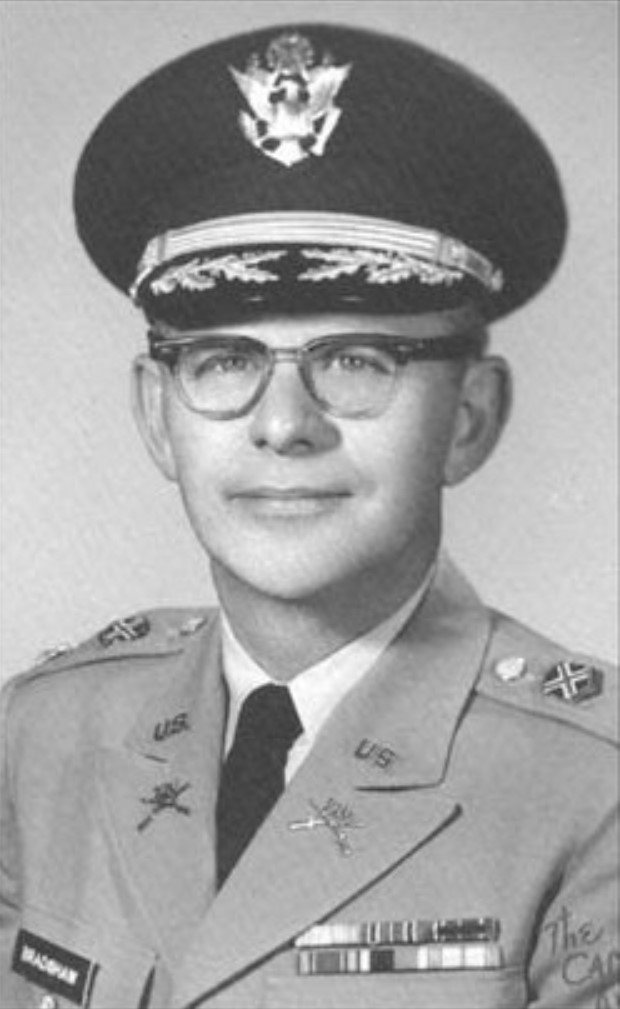
BG Robert Julian Bradshaw

BG Robert Julian Bradshaw was born 11 Mar 1921 in Rice, Virginia. He was the only son and 2nd of the 3 children born to Robert Melville and Ruth Elizabeth (Hubbard) Bradshaw. Both his paternal and maternal ancestors and their relatives had been prominent in Prince Edward and the surrounding counties of Appomattox, Cumberland, Amelia, Nottoway, and Charlotte since before the revolution. His father operated a general store and was a Postmaster at Rice,Virginia for 35 years and farmed as well.

Julian enlisted in G Company 116th Infantry Regiment, Virginia Army National Guard on 21 Jun 1937 and was a SGT in the 116th Infantry Regiment when the unit was federalized on 3 Feb 1941. He was commissioned an Infantry Officer upon graduation from Officer Candidate School class number 119 on 7 Dec 1942. His first duty assignment was as rifle and weapons Platoon Leader, Company G, 300th Infantry The Infantry School, School Troop BDE, Infantry School, Fort Benning, Georgia. he married Nancy Thurber Courter on 6 Jul 1943. He was promoted to 1LT on 16 Mar 1946 and was assigned as Executive and Training Officer, 309 Company, 43rd Replacement battalion, France and Germany. Promoted to CPT on 14 Oct 1946 he was then assigned as Company Commander, Separation Center, Fort Meade, Maryland. He rejoined G Company 116th Infantry in 1947 when the Army National Guard was reorganized following the war. 

Julian and Nancy had a daughter in 1950 and a son in 1951. Executive Officer, Company G, 116th Infantry, 29th Division, Farmville , Virginia (1950-1956). Having previously worked as a U.S. Postal clerk, Julian also took over as Postmaster for the Rice, Virginia post office in 1956. He was President of Bush River Watershed Association in 1970.

He was assigned in 1961 as Adjutant, 1st Battle Group, 29th Division, Roanoke, Virginia, promoted to MAJ on 17 Jan 1963 and assigned as Executive Officer, 2nd Battalion, 2nd Brigade, 29th Division, Lynchburg; promoted to LTC on 20 Nov 1967 and assigned as Assistant G-3/Executive Officer/Battalion Commander, HHC 2d Brigade, 29th Division, VA NG; Operations and Training Offficer/Adjutant General, HHD, Virginia National Guard; Brigade Commander, HHC, 116th Brigade, 28th Division VA NG; Brigade Commander, 3 Infantry, HHC, 116th Infantry Brigade, VA NG; Readiness Coordinator, HHD, Virginia National Guard. 1985 Commander George Washington Division Virginia State Guard.

His awards and decorations include: Reserve and Virginia National Guard Service, Virginia Legion of Merit, World War II Victory Medal, European Theater of Operations (5 Battle Stars), American Theater, American Defense.

Julian divorced Nancy 17 Aug 1980. He married Lucille Bernice Davis on 31 Jan 1981 but they divorced in July 1984. He married Elizabeth Marie Pendleton on 29 Dec 1984. Elizabeth died 29 Feb 2012.

BG Robert Julian Bradshaw passed away 24 May 2012 in Bethesda, Virginia and was interred in Pisgah Baptist Church Cemetery in Rice, Virginia.

Monday, July 18, 2011

LTC Hazael Joseph Williams

LTC Hazael Joseph Williams was born 28 Apr 1830 in Williamsville, Virginia. He was the oldest of the seven children of Hazael and Nancy Rader (McKee) Williams. His father was a carpenter, a profession that the younger Hazael would follow. He married Mary Ann Miller on 1 Jun 1856. The couple would have three children by 1861.

Hazael began his service as a Captain, commanding D Company 5th Virginia Infantry on 17 Apr 1861 immediately after the Commonwealth of Virginia voted for succession. He was promoted to Major on 21 Apr 1862 becoming the adjutant of the regiment. He was again promoted, to Lieutenant Colonel, on 29 August of that same year. His wife had a son, named after General Lee in October 1862. He was promoted yet again, to full Colonel, on 15 Nov 1862. COL Williams was commanding the regiment at the battle of Winchester on 15 Jun 1863 where he was wounded in the thigh. Eventually returning to the unit, he was wounded again, this time in the left shoulder, at the battle of Cedar Creek on 19 Oct 1864.

After the war Hazael and Mary welcomed another son who was born in November 1865 and Hazael returned to working as a carpenter and contractor as well as a farmer. The couple had four more sons and a daughter by 1874. One of those sons died in infancy in 1872. Mary died of cancer on 28 Aug 1877 leaving eight children under the age of sixteen. Hazael married Rebecca Jane McCormick in October of the next year. He and Rebecca had a daughter a year later and a son in June 1882. Elected to the Virginia House of Delegates in December 1891 he served until December 1892. In failing health for some time towards the end of his life, Hazael died at the age of eighty-one on 18 Jul 1911.

Colonel Williams rests forever in the Mount Tabor Lutheran Church Cemetery in Middlebrook, Virginia. 

NOTE: this memorial was published on the 100th anniversary of LTC Hazael's death.

Monday, January 5, 2009

MG Gilbert Jackson Sullivan

MG Gilbert Jackson Sullivan was born 5 Jul 1928, in Fredericksburg, Virginia, the 7th of 10 children of Herman Lee and Emma Jean (Hardy) Sullivan. Herman owned the family home at 802 Mercer Street in Fredericksburg, Virginia which was valued at $4000 in 1940 and supported his large family as a shoemaker in his own shop and, later, as a real estate broker.

MG Sullivan's obituary is a good summary of his professional life: "He graduated from James Monroe High School in 1945 and from the University of Virginia, School of Commerce, in 1948. At the University of Virginia, he played on the varsity football squad under coaches Frank Murray and Art Guepe, was a member of the Sigma Alpha Epsilon "SAE" Fraternity, the PK Dance Society, Lamda Pi, TILKA and the "Z" Society. Gilly served the University of Virginia for over 50 years. He began working for the University of Virginia Alumni Association during his undergraduate years and joined the staff as Assistant Director after graduation. In addition to his Alumni Association duties, he was active in organizing the Virginia Student Aid Foundation, now known as the Virginia Athletics Foundation, and served as its Secretary for 10 years.

Gilly succeeded J. Malcolm Luck as Director of the University of Virginia Alumni Association in 1958. During his career with the Alumni Association, Gilly helped start the Jefferson Scholars program in 1980, and under his leadership grew alumni giving significantly.

In 1992, Gilly was awarded the Algernon Sydney Sullivan Award, citing his "constant helpfulness to his fellow man." He was also a member of the Raven Society, the University of Virginia chapter of Omicron Delta Kappa, a national leadership fraternity, and alumni advisor to SAE. In 1993, Gilly retired as Executive Director from the Alumni Association and continued to work as a consultant for several years. His career with the Alumni Association allowed him to combine his keen interest in the business of athletic programs and service to the University of Virginia. He believed that every University of Virginia student, regardless of financial resources, should receive an exceptional education and after graduation, should give back to the University. He lived this philosophy, making it easy for this unpretentious and modest man to raise financial support for University of Virginia's students and programs. His dedicated service to the University inspired the endowment of the Gilbert J. and Ann Vernon Sullivan Jefferson Scholars Scholarship awarded annually to a University of Virginia Jefferson Scholar, the Gilbert J. Sullivan Z Society Student Internship to provide an opportunity for a summer internship otherwise unattainable because of financial constraints, and a University of Virginia Parents' Program Scholarship named the Gilbert J. Sullivan Parents Scholarship awarded to students with demonstrated records of citizenship, leadership and academic achievement.

At his retirement, alumni and friends established the Ann Vernon and Gilbert J. Sullivan Alumni Endowment to honor them. As a result of the generosity of alumni and friends, the endowment allows the Alumni Association to perpetuate the Sullivans' work on behalf of future generations of alumni.

Gilly's service also extended to his country and his community. Gilly's nearly 40 years in the military included time in the United States Naval Reserve, the United States Marine Reserve, and the Virginia Army National Guard. He rose to the rank of Major General (VA Ret) in the Virginia National Guard. His many assignments included command of the Charlottesville Monticello Guard, the 116th Infantry Regiment (The Stonewall Brigade), and Deputy Adjutant General of Virginia. He received numerous citations for meritorious service and accomplishment and was twice awarded the Commonwealth of Virginia's Legion of Honor.

Also active in the Charlottesville community, Gilly served on the Charlottesville Redevelopment and Housing Authority and was a member of the Elks Club, Lions Club and Masons.
"

MG Sullivan died on 5 Jan 2009 and now rests forever in the University of Virginia Cemetery and Comlumbarium in Charlottesville, Virginia. 

Gilbert's 1st cousin 1x removed, PVT Percy Lee Dowell, died of wounds received in combat while serving with E Company 116th Infantry in France in WWI. Their common grandfather, Ezekial Dowell, served as a PVT in E Company 19th Virginia Infantry (CSA) in the Civil War. Great-grandfather James H. Sullivan served as a PVT in B Company 30th Virginia Infantry (CSA).

Saturday, July 2, 2005

MG Archibald Alexander Sproul

MG Archibald Alexander Sproul was born 13 Nov 1915 near Middlebrook, Virginia at the old family home of Locust Grove. He was the 5th of parents William White and Katherine Rutherford (Lapsley) White's 6 children. His father farmed and then ran a general store. The family home at Moffet's Creek was valued at $10,000 in 1940 and "Arch" graduated from Washington and Lee University in Lexington, Virginia had begun working as a clerk for the unemployement office earning a reported 1939 income of $1500.

Arch enlisted in the Virginia National Guard in 1940 and was mobilized with the unit on 3 Feb 1941 and he was promoted to 2LT at the same time. He was promoted to 1LT on 28 Aug 1941 and to CPT on 18 Sep 1942. Presumably he was also assigned as Commander of I Company 116th Infantry at that time. CPT Sproul commanded I Company on 6 Jun 1944, D-Day and was awarded the Distinguished Service Cross for his actions on that day. The citation reads:

The President of the United States of America, authorized by Act of Congress, July 9, 1918, takes pleasure in presenting the Distinguished Service Cross to Captain (Infantry) Archibald Sproul (ASN: 0-406823), United States Army, for extraordinary heroism in connection with military operations against an armed enemy while serving as Commanding Officer, Headquarters Company, 116th Infantry Regiment, 29th Infantry Division, in action against enemy forces on 6 June 1944, at Normandy, France. At a time when his battalion was pinned down on the beach due to the heavy enemy rifle, machine gun and artillery fire, Captain Sproul, with complete disregard for his own safety, exposed himself on numerous occasions in encouraging and organizing the hard-pressed troops. His fearlessness in leading the men across the fire-swept beach materially contributed in converting the disorganized troops into a strong attacking force. Captain Sproul's gallant leadership, personal bravery and zealous devotion to duty exemplify the highest traditions of the military forces of the United States and reflect great credit upon himself, the 29th Infantry Division, and the United States Army.

Over the course of war CPT Sproul would be wounded 3 times and also be awarded the Bronze Star medal. During one of his hospitalizations he met a young English woman and after the war CPT Sproul returned home and began a new life, marrying Margaret Hannah Pratt on 9 May 1946. The couple would have 3 children. He was promoted to MAJ on 29 Nov 1946 and to LTC on 20 Oct 1948. He worked for over 20 years in the insurance business as a co-owner of W. J. Perry Corporation and he founded Virginia International, a trading company specializing in oil development in Indonesia in the early1970's. He also returned to service with the Army National Guard. He assumed command of the 116th Infantry Regiment in 1952 and kept that position for 7 years. In 1960 he moved to the position of Assistant Commander of the 29th Division and later Commander of the division.

General Sproul actively participated in many community and charitable services. He served on the Trinity Church Vestry, the Washington and Lee Alumni Board of Trustees, the YMCA Board of Directors, the Woodrow Wilson Rehabilitation Center Board of Trustees, the Virginia Military Institute Board of Visitors, and was one of the original members of the Historic Staunton Foundation. He was also one of the founders of the Frontier Culture Museum and he served as president of the Museum Foundation as well as a member of the Board of Trustees.

MG Sproul died on 2 Jul 2005 and was interred in Thornrose Cemetery in Staunton, Virginia.

Great, Great-grandfather Ezra Pratt served as a PVT in the American Revolution in CPT Aaron Stevens Company of COL Samuel Motts Battalion of Connecticut State Troops Jun-Nov 1776 in the Ticonderoga Campaign.Grandfather James Wood Lapsley served as a LT in E Company 51st Alabama Cavalry (CSA).

Wednesday, February 19, 2003

COL Archibald Jesse Harris

COL Archibald Jesse Harris was born 24 Aug 1874 in Atlantic, Iowa. He was the 2nd of the 8 children of Jesse and Mary Abigail (Miles) Harris. 2 of his siblings died in infancy. The family moved to the area of Fort Collins, Colorado in 1878. His father was elected Mayor of  Fort Collins, Colorado in 1911, was a livestock & real estate dealer and horseman as well as working as agent for Union Pacific Rail Road. He also served on the State Agricultural Board and State Prison Board. Archie, as he was known for most of his life, graduated with a Bachelors or Science from Colorado A&M College in 1897. The photo of Archie is from that time.

Appointed 2LT, 2nd Infantry federally recognized on 3 Aug 1898 and fought with L Company 2nd Infantry Regiment in Cuba in 1898 and 1899. He was promoted to 1LT on 16 May 1899 in Cuba. The 2nd returned to the U.S. in September 1899. The 2nd Infantry was deployed to the Philippines in August 1900. While in the islands the regiment fought in more than 25 engagements on several of the archipelago's islands. 1LT Harris returned with M Company to the western U.S. in May 1903. Archie was promoted to CPT on 30 Dec 1904 . He graduated from the Infantry and Cavalry School in 1905 then deployed with the regiment to the Philippines in May 1906. He served there posted to the Agur barracks and H Company until the regiment returned to the U.S. in March 1908. CPT Harris assumed duties as Regiment Adjutant on 1 Jun 1908 and on 7 Oct 1908 at Fort Thomas, Kentucky he married Helen J. Price.

The regiment remained at Fort Thomas until it was deployed to Hawaii in 1911. When WWI broke out the 2nd had the duty of guarding interned German ships and crews in Hawaii as well as various installations. Archie was promoted to MAJ on 15 May 1917. He was then assigned to the 362nd Infantry Regiment, 91st Division at Camp Lewis, Washington (now Fort Lewis) and in September 1917 transferred from the 362nd to the 346th Infantry Regiment in the 87th Division.

MAJ Harris was permanently promoted to LTC on 1 Jul 1920 and LTC Harris was apparently soon after sent to France where he received a temporary promotion to COL effective 2 Jul 1918 and on 21 Aug 1918 assumed command of 116th Infantry Regiment which he commanded in the opening days of the Meuse-Argonne offensive. COL Harris was relieved of command on 9 Oct 1918 but kept his temporary rank until October 1919.  COL Harris returned to the U.S. in June 1919 first going to Fort Dix, New Jersey. He was promoted to COL on 20 Jul 1920 which was made permanent on 1 Dec 1920. COL Archie Harris assumed duties as E&R officer of Fort Lewis, Washington. He was retired effective 22 Dec 1920.

After he retired and he and Helen moved to 1628 Bushnell Avenue, Pasadena, California a home valued at $4000 in 1940 and $2.4-million today. They apparently led a very quiet life. The couple had no children.

COL Harris died on 19 Feb 1953 in Pasadena, California of a heart attack while doing yard work. He was interred in Grandview Cemetery in Fort Collins, Colorado. 

NOTE: This memorial was published 50-years after his death.


Sunday, December 23, 2001

COL Mifflin Belsterling Clowe Jr.

receiving Bronze Star from COL Thrasher, 1944
COL Mifflin Belsterling Clowe Jr. was born 16 Jan 1917 in Winchester, Virginia. He was the first of the 3 children born to Mifflinn Belsterling and Eugenia Laura (Snapp) Clowe. His father had worked as a jeweler and engraver in Winchester in the family store and owned their large home at 106 North Washington Street in Winchester. Young Mifflin attended Handley High School in Winchester where he played basketball and baseball on the school teams and was in the drama club as well as student body president for 2 years. Mifflin graduated from Handley in 1937 and went to work in the family business as a clerk.

Mifflin enlisted in the local Virginia National Guard unit on 19 Jun 1935.  He was commissioned 2LT 3 Feb 1941, the same day as the units of the 116th Infantry were federalized and called to active duty. He married Mary Elizabeth Beckwith on 30 Jun 1941. At that time the 116th was still at Fort George Meade, Maryland. He was promoted to 1LT 21 May 1942. He departed with the unit for England in September 1942 and was again promoted, this time to CPT, on 15 Dec 1942 and given command of a company.

CPT Clowe commanded I Company 116th Infantry on D-Day. His actions in the amphibious assault resulted in the award of the Bronze Star Medal. CPT Clowe was wounded shortly after the landing and sent to a hospital in England where he found himself in a bed next to his friend, PVT Beverly Byrd, son of U.S. Senator Harry F. Byrd. He was promoted to MAJ 16 May 1945. After the war he returned to Winchester and he and Mary had a son in March 1947. Mifflin was a MAJ serving again in the Virginia Army National Guard when elected Mayor of Winchester, Virginia in June 1948 and he would hold that office until 1956. He was promoted to LTC on 10 Jan 1952. LTC Clowe assumed command of 2nd Brigade 29th Infantry Division in 1959 and was promoted to COL 10 May 1960. COL Clowe's command ended in 1964. He then served as chief of the office of military support at National Guard Bureau. He was considered as a possible State Adjutant General by Governor Linwood Holton. COL Clowe was also Civil Defense Coordinator for Winchester.

Mifflin was a member of several civic and fraternal organizations. He was a master mason, president of the Winchester American Legion post, member of VFW and Elks, and president Retail Merchants Association.

Mrs. Clowe died in 1997 and COL Clowe died in 2001. They rest forever in the Mount Hebron Cemetery in Winchester, Virginia. 

Great, great-grandfather Charles Bell Clowe, had served in the War of 1812. His great-grandfather, COL Henry Wyatt Clowe, served as Superintendent of the arsenal at Harper's Ferry and was there when it was attacked by John Brown in 1859.

Sunday, October 7, 2001

COL James Carr Baker

2nd Virginia Infantry Staff at Camp Cuba Libre, Jacksonville, Florida - 1898


Colonel James Carr Baker was born at "Greenwood," Winchester, Frederick county, Virginia, on 7 Oct 1851. He was first taught by private teachers, then entered Shenandoah Valley Academy, a notable  educational institution in Winchester. He witnessed the constant fighting in the area during the Civil War. James left the academy and continued his studies at Romney Institute in West Virginia then under private tutors until he began the study of law under Judge James W. Allen. James was admitted to the Virginia bar at the age of 21 and practiced law privately and as commonwealth attorney in the states of Virginia and West Virginia. Colonel Baker married Ada H. Keene on 7 Apr 1874. The couple would have 5 children. He began practice at Moorefield, West Virginia and continued there until 1876 when he accepted a position in the West Virginia government at Wheeling, where he remained until 1880. James returned to Virginia in that year, locating at Woodstock. He remained at Woodstock for nineteen years, spending 7-years in the private practice 12-years as Commonwealth's Attorney of Shenandoah county, to which he was first elected in 1884. An officer in the Virginia militia, James was a colonel of the Second Regiment Virginia National Guard in 1898 and he served with his regiment in the Spanish-American war, his regiment being held in Jacksonville, Florida, until their release from the United States service in 1899. After the war Colonel Baker re-located to Newport News, Virginia, where he practiced law from 1899 until 1906. He again re-located in 1906 to Stephens City, Virginia, and practiced law there. He was a member of the bar associations of the district, is a past master of Moorefield Lodge, Ancient Free and Accepted Masons, is a companion of Wheeling Chapter, Royal Arch Masons, belongs to the Knights of Pythias, and a practicing Episcopalian. He was a Democrat, serving for 2-years as mayor of Stephens City, 1912-13, and then as a justice of the peace. His military service in the Virginia National Guard began in 1886 and in 1898 he was elected colonel of the Second Regiment, holding that command until 1900.

COL Baker died of influenza on 17 Jan 1917 in Winchester, Virginia. He rests forever in the Mount Hebron Cemetery in Winchester, Virginia. 

This memorial was published on the 150th anniversary of COL Baker's birth.

Monday, June 18, 2001

MG John Glover Castles

MG John Glover Castles was born 1 Jan 1925 in East Orange, New Jersey. He was the youngest of the 3 children born to Eugene Franklyn and Julia L. (South) Castles. His father was a native of New York City and a fabric designer and manufacturer. His mother's family had long been living in Franklin County, Kentucky and several ancestors had been keepers or assistant keepers at the state penitentiary, postmasters,and in other government posts. The couple had met when Eugene was working as a manager of a Frankfort, Kentucky store and delivered the then Miss South's wedding dress for her marriage to another New York City man. The couple hit it off and were married in 1909 and they initially lived in Louisville, Kentucky.

Soon after John was born the family was living at 428 Ridgewood Avenue in Glenn Ridge, New Jersey in a home valued at $75,000 in 1930 together with 2 servants one of whom was the butler. However, the Great Depression had an obvious impact on the family as there were no live-in servants in 1940 and the family had moved down the block to 443 Ridgewood Avenue to a home then valued at $25,000. His father reported a 1939 income of $5,000 and was still designing fabrics. Being from a well-to-do family, John (or "Jack" as he would be called later in life) was able to graduate from Valley Forge Military Academy in 1943. He attended University of Virginia in Charlottesville, Virginia.

In 1943 he enlisted in the Army and attended OCS class 362-44 at Fort Benning, GA. He was initially commissioned as a 2LT on 22 Nov 1944. 2LT Castles would go on to serve as a platoon leader in Europe with the 345th Infantry Regiment in the 87th Infantry Division during WWII during which time he was awarded the Bronze Star. Discharged in April 1945 he returned to school. He married Dorothy Towles Rowe on 15 Apr 1950 and completed his BS degree in Economics at the University of Virginia shortly after in that same year. John originally joined the Virginia National Guard’s Charlottesville-based K Company 116th Infantry in May 1949 while he was attending the University. Promoted to CPT on 2 Mar 1953 and MAJ on 11 Mar 1957. John began work for the Farmers Home Administration in Fredericksburg before that office closed and moving to the Culpeper office as supervisor in 1959.

John and Dorothy had their first child, a daughter in January 1961. A near tragedy occurred on 30 Aug 1961 when John's stalled car was struck by a train at a crossing near Barboursville, Virginia. His left leg had to be amputated below the knee and he suffered a fractured pelvis. However, this didn't stop his military career, John attended the United States Command and General Staff College again in 1964. In May of that same year John and Dorothy had a son. Confirmed as a BG in 1974, he commanded the 116th Infantry Brigade (Separate) from 1977 to 1980. BG Castles was appointed the Adjutant General of Virginia (TAG) in August 1982 and confirmed as a MG on 24 Feb 1983. During his tenure as TAG, the Virginia National Guard went from ranking 50th in the nation to 1st in 1994. 

MG Castles died at Mary Washington Hospital in Fredericksburg, Virginia on 18 Jun 2001. He rests forever in the Oak Hill Cemetery in Fredericksburg, Virginia.

Wednesday, September 8, 1999

COL Hansford Lee Threlkeld

COL Hansford Lee Threlkeld was born in Union County, Kentucky on 17 Feb 1868. He was the 3rd of the 9 children of Uriel Hansford and Mary Catherine (Taylor) Threkeld. The family had come to Kentucky from Virginia and been in Union County in the area of Morganfield since 1811. His father farmed and in 1870 reported that his farm was valued at $3000 and the livestock thereon was valued at $2660 and that his total estate value was about $8500.

Hansford received an appointment to the United States Military Academy at West Point, New York and attended beginning in 16 Jun 1887 graduating in 1892. C\He was commissioned as a 2LT on 11 Jun 1892 to serve in B Company 13th Infantry Regiment. He participated there in rifle competition in 1893 and 2LT Threlkeld represented his regiment in the 1894 rifle competitions. In October 1894 he took a month leave. 2LT Threlkeld was detailed to serve on a Court Martial board in June 1895. He underwent an examination for promotion in 1898 and was selected in July of that year for promotion to 1LT. He was then posted to C Company 13th Infantry. 

C Company 13th Infantry found itself in Manauag, Luzon, Philippines in April 1900 and 1LT Threlkeld was commanding the company and governor of Manauag. He was promoted to CPT in 1901 and assigned to the 30th Infantry Regiment. He then was detailed to recruiting duty in Cincinatti, Ohio. 

Hansford's engagement to Elizabeth Berry Waller of Morganfield, Kentucky was announced in February 1902. The couple returned to Cincinnati to live. CPT Threlkeld was detailed to serve on a court martial board at Fort Crook in April 1904. Shortly after that he served on a promotion board. The Threlkelds had a son born in January 1905. Apparently continuing his interest in shooting competition in participated in service pistol competition in August 1906. Posted to the Philippines again in 1908, he was accompanied by his wife and stationed in Manila. The couple returned to the U.S. in 1909. Having graduated from the Army School of the Line, CPT Threlkeld attended the Army Staff College in August 1910. He took 3 months leave in June to August 1911 after which he was stationed with the 30th Infantry at the Presidio San Francisco, California for what was a planned 2 year assignment cut short by operational needs requiring CPT Threlkeld to go to Alaska in 1912. However this was interrupted when he became ill and was put on sick leave for several months which was extended for 2 months in July. However he was still considered for promotion in October of that year and he went to Jeffereson Barracks before he was supposed to continue to Alaska. However, after another month's leave he was instead assigned to the Columbus Barracks in Ohio on recruiting duty. He was relieved and returned to the 30th Infantry in June 1913 and promoted to MAJ in October 1914. By this time Austria-Hungary had declared war on Serbia beginning the first World War.

On 25 Aug 1915 MAJ Threlkeld departed for Plattsburg, New York to rejoin his regiment. The 30th had duty on the Mexican border in 1916 and MAJ Threlkeld was with them until he was ordered to report in September 1916 to attend the Army War College. After completing the course MAJ Threlkeld was on duty there as staff before being reassigned to the 35th Infantry Regiment. Promoted to COL sometime before November 1917. The relatively new COL took command of the 116th Infantry Regiment, just formed, from COL Leedy in January 1918 in anticipation of COL Leedy attending training at Fort Sam Houston. However, the retirement/discharge of BG Vaughan resulted in his reassignment as temporary commander of the 58th Brigade, the next higher headquarters in the 29th Division, being replaced by COL William J. Perry. After a replacement was found for BG Vaughan, COL Threlkeld returned to the 116th. He was then assigned to the 321st Infantry Regiment at Camp Jackson, South Carolina. It is unclear if that transfer ever happened. COL Threlkeld shipped out for France on 19 Jun 1918 aboard the Great Northern and he was still recorded as being assigned to the 29th Division. 

Once he arrived in France he was made an Assistant Chief of Staff in which position he served until his return in 1919. Initially assigned to Plattsburg, New York barracks, he requested retirement in 1920. Hansford and his wife moved back to Morganfield, Kentucky. In 1922, President Harding appointed a number of people across the country to a committee to support the raising of funds for the relief of people in the near east and Hansford was among those selected. COL Threlkeld received a silver star device to his Spanish campaign medal in recognition for gallantry at the July 1898 battle of Santiago.

Chief among the Hansford's interests was genealogy. He was a member of the American Genealogy Society, the Sons of the American Revolution, the Filson Club and the Kentucky State Historical Society. He wrote a book, Threlkeld Genealogy, which was published in 1932. Hansford was ill for several years before dying on 8 Sep 1949. 

COL Threlkeld rests forever in the Masonic Cemetery in Morganfield, Kentucky.